Key Takeaways
PIP rubber installation Orange County projects are most reliable when the substrate is stable, drainage and slope issues are corrected before placement, and the base and wear courses are installed to the designed thickness with careful edge and transition detailing. Most performance problems show up at edges, seams, or over failing bases, so proposals should clearly document prep scope, thickness verification, curing protection, and material choices matched to sun and traffic.
- Stable, well-draining base is non-negotiable: PIP rubber performs best on sound asphalt or concrete (or properly compacted aggregate where specified) with positive drainage, because movement, ponding, or persistent moisture below can lead to cracking, delamination, and premature wear.
- Layer thickness and detailing drive long-term results: The base course must be placed consistently for shock attenuation and the wear course finished evenly for appearance and traction, while edges, seams, ramps, and equipment footings need careful transitions to reduce trip hazards and early peeling.
- Compare installers by scope clarity and verification plan: Strong bids spell out what’s included for substrate prep and drainage corrections, specify thickness by zone and how it will be checked, and define cure-time and access control (including keeping sprinklers and traffic off) since curing depends on temperature, humidity, and sun exposure.
PIP rubber installation Orange County projects typically involve preparing a stable base, installing safety surfacing tiles or poured-in-place rubber, and finishing seams and edges to meet the site’s use requirements. In Orange County, this kind of surfacing is commonly specified for playgrounds, school yards, parks, and fitness areas where slip resistance and impact attenuation are priorities.
Proper installation depends on substrate condition, drainage, weather windows for curing, and material selection for UV exposure and heavy foot traffic. Contractors should follow manufacturer specs, control surface thickness, and manage transitions at curbs, ramps, and equipment footings to reduce trip hazards and premature wear, while coordinating site access and safety during work.
This guide explains the typical process step-by-step, where PIP rubber is best applied, and what to look for when comparing installers—such as experience with similar sites, scope clarity, and documentation for materials, prep, and warranties.
What to Expect From PIP Rubber Installation in Orange County
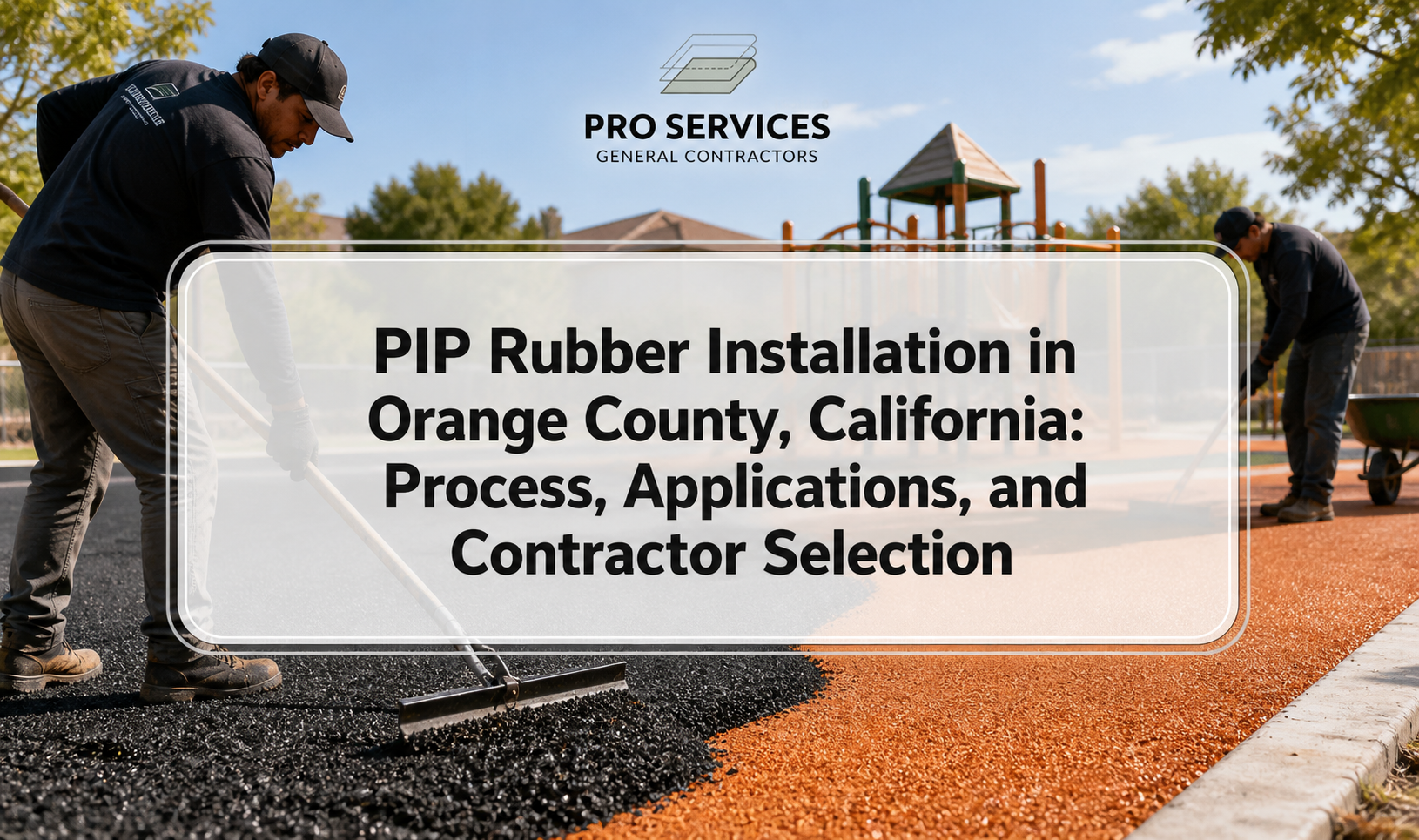
PIP rubber installation Orange County projects generally follow a predictable sequence: site evaluation, substrate prep, base and drainage corrections, rubber placement (base course and wear course), and edge/seam detailing. The main variables are the existing substrate condition, required fall protection thickness, and the weather window needed for proper curing.
Most owners choose poured-in-place rubber because it creates a seamless, slip-resistant surface with fewer trip points than loose-fill materials. It’s also commonly selected when a site needs accessible transitions, defined play zones, or custom colors and graphics.
- Common goals: reduce trip hazards, improve accessibility, and provide consistent shock attenuation.
- Common constraints: tight school/park schedules, curing time, sun exposure, and drainage limitations.
- Common decision points: thickness design, UV-stable binder choices, edge conditions, and long-term maintenance planning.
Where Poured-In-Place Rubber Works Best (and Where It Doesn’t)
PIP rubber performs best on stable, well-draining substrates in playgrounds, fitness zones, and high-traffic pedestrian areas where a seamless surface is beneficial. It can be a poor fit on moving or failing bases, or in areas with persistent drainage problems that keep the system wet.
Ideal use cases around Orange County
Sites with predictable foot traffic, defined equipment footprints, and controlled irrigation patterns are usually the best candidates for PIP. These are also the sites where consistent accessibility and cleanability matter most.
- Playgrounds at schools, parks, and early learning centers
- Recreation and fitness zones (calisthenics pads, outdoor gyms)
- Courtyards and multi-use activity areas needing smooth transitions
- Path connectors between play areas and ramps (when properly detailed)
If you’re comparing surfacing types for a play area, it can help to understand lifecycle tradeoffs; see why cheap surfacing costs more long-term for a planning-oriented perspective.
Situations that require extra design or a different surface
Some conditions don’t automatically rule out PIP, but they do require more engineering, better prep, or a different product choice. Skipping these considerations is a common cause of premature cracking, edge curl, or delamination.
- Unstable subgrades: settlement or pumping soils can telegraph cracks into the rubber.
- Persistent standing water: chronic ponding can accelerate wear and binder breakdown.
- Heavy rolling loads: frequent carts/vehicles may require a thicker or alternative system.
- Aggressive irrigation/overspray: can contribute to algae/mildew and slickness if not managed.
- Edge exposure: open edges without proper restraint are more likely to lift or ravel.
Step-by-Step: Typical PIP Rubber Installation Process
While manufacturer instructions vary, most poured-in-place systems are installed in layers over a prepared substrate, then detailed at edges, posts, and transitions. The quality of base preparation and the installer’s consistency with mixing, timing, and thickness control often determine how the surface performs long-term.
1) Site walkthrough, measurements, and scope confirmation
Installers typically confirm site access, utility constraints, elevations, and existing conditions before material ordering. This is also when thickness requirements and edge conditions should be finalized.
- Measure total square footage and confirm play equipment footprint locations
- Identify edge restraints (curbs, headers, walls) and transition details
- Confirm work hours, staging areas, and protection of adjacent landscaping
- Document pre-existing cracks, ponding, and substrate damage
2) Substrate evaluation (asphalt, concrete, or aggregate base)
PIP rubber depends on a stable, properly sloped base. If the substrate is failing, the rubber layer can’t “fix” it—movement below often becomes cracking above.
- Asphalt: should be sound, properly compacted, and sloped for drainage; repairs may be needed at alligator cracking or soft spots.
- Concrete: needs appropriate surface prep and crack treatment; control joints and movement must be addressed in the design.
- Aggregate base (for some systems): must be compacted and graded correctly; drainage design is critical.
3) Drainage and slope corrections
Drainage is one of the most important performance factors because water that doesn’t leave the area tends to find the weakest interface. Orange County sites also deal with irrigation overspray and occasional heavy rain events that quickly reveal low spots.
- Confirm positive drainage away from buildings and toward approved collection points.
- Correct birdbaths/low areas before rubber goes down.
- Coordinate with irrigation adjustments to reduce overspray onto the surfacing.
4) Cleaning and surface preparation
Bond strength depends on surface cleanliness and texture. Dust, curing compounds, oils, and loose material can reduce adhesion.
- Remove debris, mud, vegetation, and loose aggregate
- Pressure wash or mechanically clean where needed
- Allow the substrate to dry adequately before priming or placement
- Mask/plan protected areas (walls, curbs, equipment bases)
5) Primer (when specified) and detailing plan
Some systems use primers to improve adhesion to the substrate; others rely on direct bonding methods specified by the manufacturer. Edge and penetration detailing should be planned before mixing begins because working time is limited.
- Confirm manufacturer-approved primer and application rate (if required)
- Pre-stage materials, trowels, screeds, and mixing equipment
- Lay out thickness guides and elevation controls
6) Base layer placement (impact/structural course)
The base course is typically thicker and engineered for shock attenuation, so thickness consistency is critical. Installers usually place and trowel the mix to the designed depth and profile.
- Mix rubber granules with binder according to manufacturer ratios
- Place in manageable sections to avoid cold joints
- Use screed rails/guides to maintain uniform thickness
- Compact/trowel consistently, especially near edges and equipment footings
7) Wear layer placement (color/finish course)
The wear course is the visible top layer and is often where owners notice quality first—uniformity, smoothness, and clean transitions. UV exposure and heavy foot traffic in Orange County make material selection and finishing technique especially important.
- Confirm color blend consistency and batch planning (to reduce shade variation)
- Place the wear course evenly to avoid thin spots and visible telegraphing
- Finish with consistent trowel technique for traction and appearance
- Detail around drains, posts, and edges without creating lips or dips
8) Seams, edges, and transitions (trip-hazard prevention)
Most early failures occur at edges, seams, or penetrations, not in the middle of the field. Good detailing reduces water intrusion and mechanical peeling.
- Curbs/headers: ensure tight bond and clean line; avoid feathering to zero thickness unless the system allows it.
- Ramps/paths: maintain smooth transitions to adjacent concrete or asphalt.
- Equipment footings: seal around posts and bases where movement and moisture can concentrate.
9) Curing, protection, and reopen schedule
Curing time depends on the system, ambient temperature, humidity, and direct sun exposure. Reopening too early can cause permanent dents, scuffs, or surface tearing.
- Block access with fencing/tape and clear signage
- Prevent sprinklers from running onto uncured material
- Coordinate deliveries and other trades to avoid traffic on fresh surfacing
For a deeper overview of staging and sequencing, you can reference the PIP process page for additional context.
Material and Design Choices That Affect Performance
The same “poured rubber” label can represent different systems, binders, and layer designs. Matching materials to UV exposure, usage intensity, and site conditions is a key part of getting predictable results.
Thickness planning and impact attenuation requirements
Thickness is commonly tied to the fall height of playground equipment and the chosen system’s performance targets. Because requirements vary by site and equipment, installers typically coordinate thickness design with the project’s safety and documentation needs.
- Confirm equipment locations and highest accessible play components
- Plan for thickness transitions between zones (play area vs. perimeter paths)
- Document the thickness specification and how it will be verified during install
UV exposure, color stability, and binder selection
Orange County sun exposure can be intense, especially in open parks and schoolyards with limited shade. UV-stable binders and appropriate wear-layer selection can help reduce fading and surface embrittlement over time, though no outdoor surface is completely unchanged by weather.
- Ask what binder system is specified for the wear layer and why
- Plan for shade structures or trees where heat buildup is a concern
- Consider darker colors carefully in full sun due to surface temperature comfort
If shade is part of the site plan, integrating overhead protection early can prevent last-minute conflicts with footings and surfacing edges; see shade structures for related planning considerations.
Comparison Table: Key Decisions to Confirm Before Installation
Use the checklist below to compare installer proposals and reduce scope gaps. These items are less about “brand preferences” and more about making sure the installation method matches the site’s conditions and expectations.
| Project Item | What to Confirm in the Specifications | Orange County Site Considerations |
|---|---|---|
| Substrate readiness | Repair plan for cracks/soft spots, surface cleaning method, and whether primer is specified | Older asphalt at schools/parks may need patching and regrading before rubber placement |
| Drainage and slope | Target slope direction, treatment of low spots, and edge drain interface details | Irrigation overspray and occasional heavy rains make ponding prevention a priority |
| Thickness control | Planned thickness by zone, method for depth checks, and transition detailing | Multiple-use campuses often require thickness changes between play areas and walk paths |
| Edges, seams, and penetrations | Edge restraint type, seam layout strategy, and detailing around posts/footings | Perimeters near curbs and ramps should be finished to minimize trip risks and peeling |
| Curing and site protection | Minimum cure time, weather limitations, and protection plan to prevent early traffic | School schedules and public park access require clear closures and reopen coordination |
How to Compare Installers for PIP Rubber Installation in Orange County
Installer selection should focus on clarity of scope and demonstrated ability to manage substrate prep, thickness control, and details—not just surface appearance on day one. A strong proposal reads like a plan: what’s included, what’s excluded, and how quality will be verified.
What a well-defined proposal usually includes
Bid comparisons are easier when each contractor is pricing the same assumptions. When details are missing, change orders and performance disputes become more likely.
- Substrate prep scope (patching, crack repair approach, cleaning method)
- Drainage corrections (what is included vs. excluded)
- Layer design: base course and wear course thicknesses
- Color plan, graphics (if any), and how seams will be managed
- Cure time assumptions and access control plan
- Material documentation and warranty terms (what is covered and what isn’t)
Questions that reveal experience with similar sites
Ask questions that force specifics about your conditions rather than general capability. This tends to uncover whether the installer has handled similar drainage, access, and detailing challenges.
- How will you verify thickness during installation in multiple zones?
- What is your plan for transitions at ramps/curbs to avoid lips?
- How do you address existing cracks or control joints in the substrate?
- What weather conditions would delay installation, and how do you protect staged materials?
- How will you keep irrigation off the surface during cure?
Maintenance Planning: Keeping PIP Rubber Performing and Looking Good
PIP rubber is durable, but it’s not maintenance-free—routine cleaning and early repair of minor damage can extend service life. Most sites benefit from a simple schedule aligned with usage intensity and nearby landscaping or sand areas.
- Weekly/biweekly: blow off leaves and debris; remove gum/litter promptly to reduce staining.
- Monthly/quarterly: wash as needed to limit algae/mildew in shaded or damp areas.
- After storms or heavy use: inspect edges, seams, and high-wear zones near entries and swings.
For a more detailed upkeep framework, review PIP maintenance and use it to align responsibilities between owners, custodial teams, and contractors.
Related Surface Options: When Porous Rubber or Turf May Fit the Site Better
Some Orange County projects benefit from alternate surfaces based on drainage needs, aesthetics, or multipurpose programming. Comparing options early helps avoid forcing a single product into a site that needs a different approach.
Porous rubber surfaces for drainage-forward designs
Where managing surface water is the top priority, porous rubber systems may be considered as part of an overall drainage strategy. Suitability still depends on base design and maintenance expectations.
To explore where these systems are commonly used, see porous rubber surfaces.
PIP vs. other playground surfacing types (context for decision-making)
Understanding the broader category of playground surfacing can help stakeholders align on safety, accessibility, and maintenance expectations. For general background and terminology, refer to playground surfacing.
Planning Your Next Steps for a Smoother, More Durable Install
The most reliable PIP rubber installation Orange County outcomes come from aligning three things: a stable, well-draining substrate; a clearly defined thickness and detailing plan; and a realistic schedule that protects curing. When you evaluate proposals, prioritize scope clarity and documentation so the finished surface matches the site’s safety goals and daily use patterns.
If you’re still deciding on system type, colors, or where PIP is best applied on your property, start by mapping traffic patterns, drainage flow, and transitions at every edge. Those details tend to determine long-term performance more than any single aesthetic choice.
For more information on the service itself and typical applications, review Poured In Place Rubber and use it as a reference when comparing installation approaches and maintenance expectations.
Frequently Asked Questions
Get Clear Next Steps for Your Orange County PIP Rubber Install
If you’re planning poured-in-place rubber for a playground, school yard, park, or fitness area, a quick project conversation can help you confirm whether your base, drainage, and edge conditions are ready for a durable, seamless surface. Getting these details right upfront can reduce change orders, scheduling issues, and avoidable wear later.
Orange County sites often face tight access windows, irrigation overspray, and sun exposure—factors that influence thickness planning, transitions, and cure protection. A professional review can clarify scope, documentation, and what’s realistically required before installation begins.