Walkways
Paths and walkways
Seamless routes through parks, campuses and common areas that keep draining while it rains.
Porous Rubber · Pervious Pavement
Pervious rubber pavement is the single-layer form of porous rubber: recycled tire rubber granules bound together and troweled in place with open voids, so rainwater soaks through instead of running off. We install it for walkways, patios, courtyards and school blacktops across San Diego, Orange, Riverside and Los Angeles Counties.
★★★★★★★★★★ 4.6 out of 5 based on 10 Google reviews

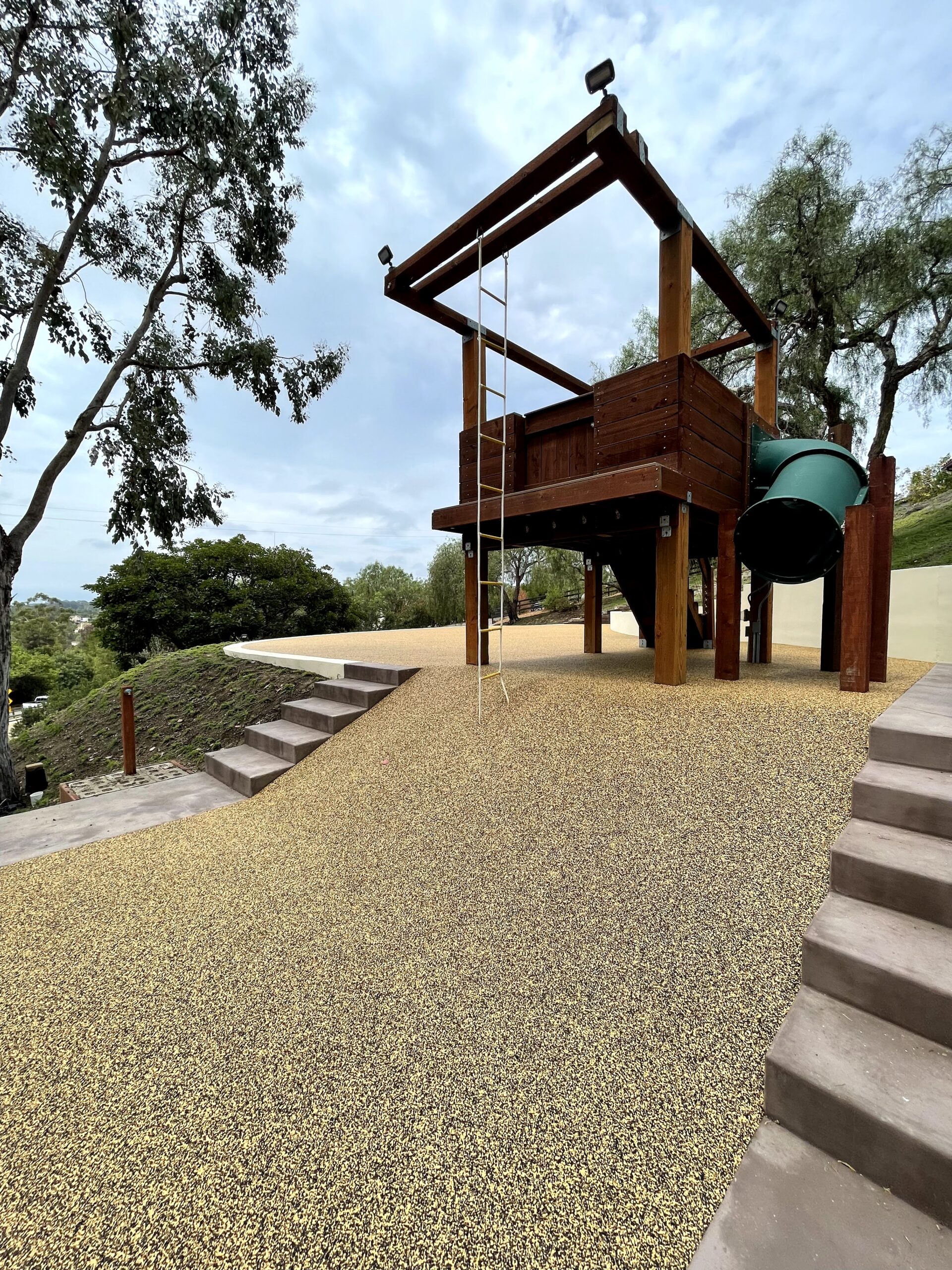
Pervious rubber pathway with concrete edging
Quick Answer
Pervious rubber pavement is a seamless paving surface made from larger recycled rubber granules mixed with a binder and troweled in a single layer. The gaps between the granules let rainwater pass straight through to the base, so the surface drains and dries quickly instead of holding puddles.
It is the most open, fastest-draining of the three porous rubber systems we install. It suits pedestrian and recreational paving such as walkways, patios, courtyards, play-area paths and school blacktops, and it is firm enough for strollers, wheelchairs, bicycles and light vehicles.
Pervious pavement at a glance
Applications
Pervious pavement fits outdoor surfaces that people walk, roll and play on, especially where puddles, runoff or hard paving are a problem.
Walkways
Seamless routes through parks, campuses and common areas that keep draining while it rains.
Outdoor living
A softer, slip-resistant alternative to concrete for patios, courtyards and seating areas.
Schools
Resurface hard play yards and the paths that lead to play equipment. Under the equipment itself we specify poured-in-place rubber.
Recreation
A comfortable, quick-drying surface for recreational walking and jogging routes.
Pool areas
A textured surface that stays walkable when wet, laid to the shape of the deck.
Service routes
Service paths and routes with light vehicle traffic. We confirm the expected traffic during the site review so the base is specified for it.
Why Porous Rubber
Rigid paving sheds water and cracks as the ground moves. Pervious rubber handles both differently.
Water passes through the open surface into the base, reducing puddles and surface runoff.
Tolerates small ground movement and root growth instead of cracking like concrete.
A textured surface that stays walkable when wet.
More give than concrete or asphalt for walking and play.
Poured in place, so it follows curves, slopes and edges without joints.
Made mostly from recycled tire rubber, giving used tires a second life.
Base & Drainage
Pervious rubber pavement only drains through when the layers beneath it can take the water. We specify the base for each site after looking at the soil, slope and how the area will be used.
The usual choice for full drainage: water passes through the rubber into the aggregate and subsoil.
Possible where existing pavement stays. The surface no longer drains through, but keeps its give and traction.
Paths are often bordered by concrete curbs or other edging that defines the shape of the pour.
It can follow slopes and bends; we check grades and transitions to adjacent paving during the site review.

Benefits & Limitations
A clear view of both sides helps you decide whether pervious rubber pavement suits your site.
| Topic | Strength | Limitation to plan for |
|---|---|---|
| Drainage | Water passes through when it is laid over a compacted crushed base | Over concrete or asphalt, water no longer drains through; the pores must be kept clear of debris |
| Surface | Open, textured, slip-resistant finish | The granular texture is less smooth than an EPDM wear layer |
| Use | Pedestrians, strollers, wheelchairs, bicycles, skateboards and light vehicles | Not a fall-height safety surface; under play equipment we specify poured-in-place rubber |
| Color | Earth tones that resemble asphalt or stone | A wider color range needs a two-layer system with an EPDM wear layer |
| Upkeep | Damaged spots can be repaired and worn areas resurfaced | Needs regular sweeping and weed removal to keep draining |
Want a smoother, more colorful finish? A two-layer system with a colored EPDM wear layer is often used for sidewalks. See rubber sidewalks
Design & Materials
Pervious pavement is one of three porous rubber systems. We recommend the one that fits your traffic, drainage and look.
Most open
Larger recycled granules for the fastest drainage, pigmented to resemble asphalt or stone.
Smoother finish
A recycled-rubber base topped with colored EPDM for a smoother surface and more color choices.
Natural look
Shredded recycled rubber bonded into a porous, natural-looking surface for nature paths and tree wells.
Our Process
Every project follows the same five steps we use across all of our surfacing work.
01
We learn how the area is used and what you want solved, such as puddling or cracked paving.
02
We measure the area and check slopes, drainage, existing paving and nearby trees.
03
We recommend the system, base, thickness and colors, then provide a written estimate.
04
The base is built or existing pavement prepared, then granules and binder are mixed on site and troweled in place.
05
After the surface cures, we walk it with you and explain simple care to keep the pores open.
Timing depends on the size of the area, base work, weather and cure time. See our process
Project Gallery
Porous rubber paths, slopes and play-area surfacing from our project photos.
Related Surfacing Solutions
Other porous rubber applications and surfaces that pair with pervious pavement.
Overview of porous rubber systems, bases and care.
Flexible, permeable sidewalks and walkways.
Softer recreational trails through parks and campuses.
Safety surfacing for areas under play equipment.
How we take projects from site review to final walkthrough.
More surfacing projects from across Southern California.
FAQ
Common questions about pervious rubber pavement, its base, where it fits and how to care for it.
Talk to a surfacing specialist
Get help choosing, designing and scoping the right surface.
Pervious rubber pavement is a single layer of larger recycled tire rubber granules mixed with a binder and troweled in place. Open voids between the granules let rainwater drain through to the base.
It is flexible and porous. Water passes through it instead of running off, it has more give underfoot, and it tolerates small ground movement and root growth instead of cracking. It is used for pedestrian areas and light vehicle traffic.
For full drainage it is installed over a compacted crushed aggregate base. Base requirements vary by region and soil, so we specify the base for each project after the site review.
Yes. Over concrete or asphalt the surface no longer drains through, but it keeps its flexibility, resilience and slip resistance.
It works well for school blacktops, play-area paths and walkways around a playground. Directly under play equipment, where children can fall from height, we specify poured-in-place rubber, whose cushion depth is matched to the equipment’s critical fall height.
Single-layer pervious pavement comes in black, brown, brick red, tan, green and gray, pigmented to resemble asphalt or stone. A two-layer system with an EPDM wear layer offers more colors.
Sweep or blow off leaves and dirt so the pores stay open, remove weeds that grow through, and wash stains with a mild detergent and a soft brush. Small damage can be repaired, and worn areas can be resurfaced.
We install porous rubber throughout Southern California, including San Diego, Orange, Riverside and Los Angeles Counties. See all areas served.
Free Estimates
Tell us about the area and how it’s used. We’ll recommend a porous rubber system and base for your site and send a free estimate.
Request an Estimate
Our playground surfacing specialists are here to assist you at every stage of the process, from choosing the right product to design and installation.
(888) 902-3777
info@playgroundsafetysurfacing.pro
San Diego, Orange, Riverside & LA Counties
Fields marked * are required.
"*" indicates required fields