Key Takeaways
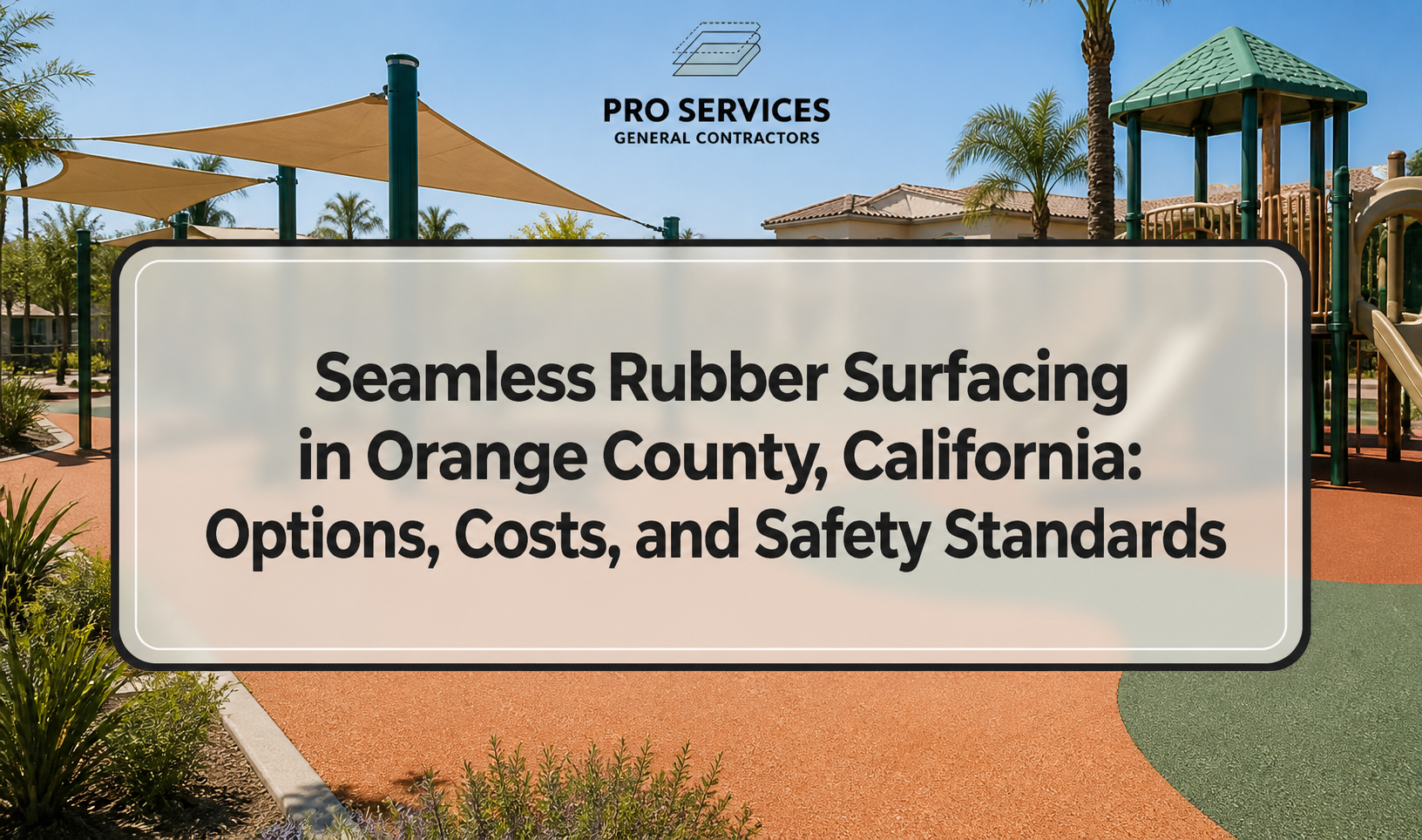
Seamless rubber surfacing Orange County projects use is a poured-in-place, joint-free system typically built with polyurethane-bound rubber (often an SBR base with an EPDM wear layer) for slip resistance, accessibility-friendly transitions, and impact attenuation where required. Real-world performance and pricing depend heavily on base preparation, drainage design, and thickness strategy tied to the site’s use, exposure, and (for playgrounds) fall-height needs.
- System selection and build-up: Most proposals specify a two-layer system (SBR base for economical thickness + EPDM wear layer for color and improved UV resistance), with the right blend depending on usage, sun exposure, and budget priorities.
- Cost is driven by site realities: Pricing is usually shaped less by the “rubber” itself and more by required thickness, substrate condition and repairs, drainage approach, layout complexity (curves/patterns/colors), demolition/disposal, and access or phasing constraints.
- Safety, drainage, and transitions need verification: For playgrounds, thickness is typically designed around equipment fall height and discussed using ASTM testing approaches (with “meets standard” claims incomplete without the test method, target fall height, and exact build-up), while many long-term problems start with unclear drainage paths and poorly detailed edges, drains, and flush transitions.
Seamless rubber surfacing Orange County property owners choose is a poured-in-place, continuous safety surface commonly used for playgrounds, pool decks, fitness areas, and accessibility routes where slip resistance and impact attenuation matter. In Orange County, California, options typically include EPDM or SBR rubber bound with polyurethane and installed over a properly prepared base to create a joint-free finish.
Material selection, thickness, drainage design, and site conditions directly affect performance and cost, especially in high-traffic community spaces and sun-exposed outdoor areas. For safety-focused installations, projects are often designed around recognized playground and accessibility guidelines such as ASTM impact testing practices and ADA-related slope and transition requirements, which can influence specifications and inspection needs.
This introduction outlines the main options available locally, what drives pricing on real sites, and how safety standards are commonly applied so you can compare proposals with clear expectations before scheduling an on-site evaluation.
What seamless rubber surfacing is (and where it performs best in Orange County)
Seamless rubber surfacing Orange County sites rely on is typically a troweled, poured-in-place rubber system designed to create a continuous, slip-resistant, impact-attenuating surface for outdoor and indoor recreation areas.
Because it cures into a joint-free field, it’s commonly specified where trip hazards, shifting seams, or loose-fill materials would create maintenance or accessibility issues. In Orange County, it’s frequently used in sun-exposed locations, so UV stability, color retention, and heat management become practical design considerations.
- Playgrounds: Under and around play equipment where fall protection is a priority and maintenance needs to be predictable.
- Pool decks and splash zones: Wet areas where traction, drainage, and comfort underfoot matter (surface selection still needs to account for water treatment chemicals and cleaning routines).
- Fitness and outdoor gyms: Areas that benefit from cushioning, noise reduction, and easy cleanup.
- HOA and community routes: Paths and amenity spaces where a smooth transition and stable footing support accessibility.
- Schools, preschools, and childcare: Spaces that often need both safety performance and durable daily cleanability.
Material options you’ll see in proposals: EPDM vs. SBR (and hybrid builds)
Most local systems use an SBR base layer for bulk thickness and an EPDM wear layer for color and UV performance, but the right blend depends on usage, exposure, and budget priorities.
SBR rubber (often used as the base course)
SBR is commonly selected for the lower layer because it’s cost-effective for building thickness and can contribute to impact attenuation when installed over a suitable base.
- Typical role: Base mat layer under an EPDM topcoat.
- Strengths: Helps manage overall system cost, supports required thickness for safety performance.
- Limitations: Not typically the preferred exposed wear surface where color, UV stability, and aesthetics are important.
EPDM rubber (often used as the wear course)
EPDM granules are widely used for the top layer because they can provide better color stability and a more finished appearance for public-facing spaces.
- Typical role: Wear layer (top course) over an SBR base.
- Strengths: Color options, improved UV resistance relative to many base-layer materials, good aesthetics for parks and campuses.
- Limitations: Material cost is typically higher; light colors can show dirt more readily in high-traffic areas.
Binder and system build considerations
Polyurethane binders are commonly used to bond rubber granules into a monolithic surface, and performance depends heavily on correct mixing, placement, and curing conditions.
- Two-layer systems: Often selected for playgrounds and civic spaces to balance cost (SBR base) with appearance (EPDM top).
- Single-layer systems: Sometimes considered for limited-use areas, but may reduce design flexibility for color and wear performance.
- Moisture sensitivity: Installation timing matters; humidity, fog, or substrate moisture can affect curing and long-term bond strength.
What drives cost on real Orange County sites
Pricing is usually shaped less by the “rubber” itself and more by site prep, safety thickness requirements, drainage design, and the complexity of edges, shapes, and access.
Since every playground and amenity space is different, proposals can vary widely even when square footage looks similar. Comparing bids is easier when you separate “base construction” from “surfacing system” and confirm each scope item is clearly included.
- Required thickness (safety design): Greater thickness to meet a specific fall-height target increases material and labor.
- Substrate condition: Cracked asphalt, failing concrete, or uneven grades can require repairs or replacement before surfacing begins.
- Drainage approach: Poor drainage can shorten lifespan; adding slopes, drains, or a permeable base changes scope.
- Layout complexity: Curves, patterns, inlays, and multiple colors add labor and waste factors.
- Access and logistics: Tight gates, stairs, long hose runs, rooftop staging, and limited parking can add time.
- Demolition and disposal: Removing tile, turf, loose-fill, or old rubber adds disposal and base restoration work.
- Phasing and downtime constraints: Working around school schedules or keeping partial access open can slow production.
Thickness, fall protection, and how standards are commonly applied
For playground applications, poured rubber thickness is typically designed around the equipment’s fall height and verified through impact attenuation testing practices rather than “one-size-fits-all” rules.
In the U.S., surfacing performance is often discussed using ASTM testing approaches and public playground guidance, but the correct target for your site depends on the equipment, the finished base, and the final installed thickness consistency across the use zone. If safety compliance is critical (schools, cities, licensed childcare), it’s reasonable to ask how the installer plans to confirm field thickness and whether testing documentation is available.
- Key design input: Maximum equipment fall height and the required use zone footprint.
- System variables: Rubber type, binder content, layer thickness, and substrate stiffness can all influence test outcomes.
- Quality control checkpoints: Depth checks during install, documenting layer thickness, confirming transitions and edges are flush.
- Important limitation: “Meets standard” claims can be incomplete without specifying the test method, target fall height, and whether the result applies to your exact build-up.
If you’re comparing alternatives, it can help to review a general overview of playground surfacing categories so you can understand what seamless rubber is being compared against and why maintenance and accessibility can differ across surface types.
Drainage and base design: where many problems start (or get prevented)
Even the best seamless rubber surfacing can underperform if water has nowhere to go, so base slope, drainage pathways, and substrate stability should be addressed before the wear layer is installed.
In Orange County, sudden rain events and irrigation overspray can expose drainage weaknesses quickly. A well-designed base helps avoid ponding, reduces the risk of premature edge lifting, and keeps the surface more consistent underfoot.
Common base options under poured rubber
The “right” base depends on whether you want impermeable drainage-by-slope or a permeable system that lets water pass through.
- Concrete slab: Stable and durable; relies on proper slope to drains/edges and crack management.
- Asphalt: Often used for playgrounds; requires proper compaction, smoothness, and drainage-by-slope.
- Permeable base systems: Can be paired with porous rubber approaches; design details matter (soils, reservoir layer, overflow path).
Drainage details to confirm in your scope
Small detailing choices—like how edges terminate—can decide whether water stays on the field or exits cleanly.
- Finished slope plan: Confirm slope direction and where water is intended to discharge.
- Edge containment: Verify curbs, headers, or flush terminations to prevent edge breakdown.
- Drain interfaces: Ensure drain rings and frames are compatible with rubber surfacing transitions.
- Irrigation review: Redirect spray heads to reduce constant wetting and chemical exposure.
Slip resistance, heat, and UV exposure in coastal and inland OC microclimates
Traction and temperature comfort depend on texture, aggregate profile, color choice, and exposure—not just the material name—so it’s worth making these decisions early.
Coastal fog, pool splash-out, and sunscreen/oils can affect slip behavior, while inland summer heat can influence comfort and color selection. No outdoor surface stays “cool” in full sun, but design choices can reduce heat load and improve usability during peak hours.
- Texture and finish: Ask what finish is typical for wet areas and how it’s cleaned without polishing it smooth over time.
- Color strategy: Lighter colors can reduce surface temperature compared to very dark tones, but may show dirt more readily.
- Shade planning: Shade structures can improve comfort and help preserve color (where feasible).
- Cleaning chemistry: For pool-adjacent installs, confirm compatible cleaners and pressure-washing limits.
Accessibility and transitions: what to look for in a “seamless” scope
Seamless surfacing supports accessibility goals when slopes, transitions, and edge conditions are built correctly and remain stable over time.
Many accessibility issues come from transitions to concrete, drain rings, ramps, and perimeter curbs—not the middle of the field. If the site includes routes, gates, or inclusive play elements, confirm that the design accounts for smooth transitions and avoids lips at borders.
- Flush edges at hardscape: Reduces trip hazards and wheeled mobility resistance.
- Consistent thickness at transitions: Prevents abrupt changes in level that can catch wheels or toes.
- Control joints planning: If placed over concrete, ask how underlying joints/cracks are addressed to reduce telegraphing.
- Route continuity: Ensure the accessible route isn’t interrupted by edging, drains, or abrupt texture changes.
Seamless rubber surfacing options by application type
Design priorities change by site type—playgrounds emphasize impact attenuation, while pools and fitness areas often prioritize traction, drainage, and cleanability.
Playgrounds and schools
Playgrounds often need a clearly defined use zone, thickness matched to fall height, and durable borders that handle daily traffic and wheeled equipment.
- Good fit for: Elementary schools, parks, preschools, inclusive play areas.
- Key specs to confirm: Target fall height, thickness map, drain plan, edge containment detail.
- Operational needs: Easy cleanup, minimal tracking, predictable inspection routines.
Pool decks and splash areas
Pool-adjacent rubber can be comfortable and slip-resistant, but it must be detailed for wet conditions and chemical exposure.
- Good fit for: Community pools, splash features, HOA pool surrounds.
- Key specs to confirm: Drainage-by-slope, texture/finish, compatible cleaning practices.
- Operational needs: Regular cleaning to manage sunscreen/oils and maintain traction.
HOAs, multifamily amenities, and community spaces
For HOAs, durability and appearance are usually the priority, with predictable maintenance and long-term patchability important for budgeting.
- Good fit for: Tot lots, courtyards, dog-wash adjacent areas (site-specific), walking connectors between amenities.
- Key specs to confirm: UV-stable wear layer selection, edge protection, access for future repairs.
- Operational needs: Stain management plan and restrictions for pressure washing or harsh solvents.
Installation process overview: what “good” typically includes
A reliable installation plan includes base verification, moisture management, controlled mixing, and protection during cure—because workmanship is a major driver of lifespan.
If you want to see what’s commonly included step-by-step, review the poured-in-place process so you can compare it to the sequence shown in proposals and schedules.
- Site verification and layout: Confirm square footage, transitions, patterns, and drainage routes.
- Base preparation: Repair cracks, correct grades, clean substrate, and verify edge containment.
- Priming (as specified): Improve bond to substrate where required by system design.
- Install base course (often SBR): Place and trowel to thickness; perform thickness checks.
- Install wear course (often EPDM): Apply top layer for durability and finished appearance.
- Cure and protect: Restrict traffic, protect from moisture intrusion, and confirm readiness for reopening.
- Risk to watch: Installing over a damp substrate or during unfavorable weather windows can reduce bond strength and create early failures.
- Verification step: Ask how thickness is checked across the field, not only at edges.
Maintenance expectations and realistic lifecycle planning
Seamless rubber surfacing is not maintenance-free, but routine cleaning and periodic inspections are usually straightforward compared with loose-fill options.
Most sites benefit from a documented cleaning routine, especially where food, trees, irrigation, or pool chemicals are present. It’s also smart to clarify how repairs will be handled for vandalism cuts, burn marks, or localized wear—because “seamless” doesn’t mean “unrepairable,” but patches may be visible.
- Routine tasks: Sweep/blow debris, rinse as needed, address stains promptly to reduce discoloration.
- Periodic checks: Look for edge separation, low spots/ponding, cracks telegraphing from the base, and high-wear lanes.
- Repair planning: Ask how color matching is approached for future patches and what lead times are typical for matching granules.
For a deeper look at upkeep tasks and scheduling, see poured-in-place rubber maintenance.
Quick reference: what to confirm when comparing proposals
A good bid comparison checks system build-up, base scope, drainage plan, and how thickness and transitions will be verified—not just total price and color samples.
| Proposal Item to Compare | What to Look For in Specifications | Practical OC Site Considerations |
|---|---|---|
| System build-up (layers) | Whether it’s a 2-layer system (e.g., SBR base + EPDM wear) and stated layer thicknesses | Sun exposure and aesthetics often make an EPDM wear layer worth confirming for parks/HOAs |
| Thickness basis for playgrounds | How thickness is determined (fall height/use zones) and how field thickness will be checked | Schools/cities may require clearer documentation and consistent thickness across equipment zones |
| Base scope and repairs | Who owns crack repair, patching, leveling, and surface cleaning before install | Older asphalt/concrete and irrigation overspray can make base prep a major cost variable |
| Drainage plan | Planned slopes, drain locations, edge terminations, and ponding tolerance expectations | Sudden storms and pool splash-out can reveal low spots quickly; drainage clarity prevents disputes |
| Cure and access control | Cure time assumptions, barricading plan, and weather/moisture contingency | Coastal humidity and marine layer conditions can affect scheduling and cure protection needs |
How to choose between seamless rubber and other surfacing approaches
The best surface is the one that matches your safety goals, accessibility needs, maintenance capacity, and site realities like trees, drainage, and heat exposure.
Seamless rubber surfacing Orange County decision-makers often compare it against synthetic turf, tiles, or loose-fill. While turf can work well in some layouts, long-term cost and maintenance tradeoffs deserve attention—especially when shortcuts are taken on base prep or drainage design.
- Choose seamless rubber when: You need a stable, joint-free surface, predictable accessibility, and fall protection in defined zones.
- Consider other options when: You want a specific aesthetic (landscape look), have significant tree root activity, or need a permeable landscape system—while accepting different maintenance needs.
- Decision tip: Review long-term risks before selecting the lowest bid; why cheap surfacing costs more long term can help frame what to watch for in materials, base prep, and workmanship.
Planning your next steps for an Orange County project
A smooth project starts with clarifying goals (safety, drainage, accessibility, aesthetics) and then translating them into a scope that installers can price consistently.
- Document the site: Note square footage, photos of edges and drains, and any existing cracks/ponding.
- Confirm use and performance needs: Playground fall heights, wet-area traction expectations, and accessibility transitions.
- Ask for a thickness and drainage narrative: Not just colors—request how thickness is determined and where water goes.
- Compare “apples to apples”: Ensure every bid includes the same base prep, edge details, and curing/protection plan.
- Plan for maintenance: Establish cleaning methods and responsibilities so the surface performs as intended over time.
If your scope includes a dedicated safety surface install, start by reviewing poured in place rubber so you can align terminology, layer expectations, and typical application details before finalizing specifications.
Frequently Asked Questions
Get a clear scope and confident specs for your poured-in-place rubber surface
If you’re planning seamless rubber surfacing for a playground, pool deck, fitness area, or HOA amenity in Orange County, the next best step is an on-site review that confirms the base condition, drainage path, edge transitions, and the thickness strategy for your specific use areas. That clarity helps you compare proposals fairly and avoid change orders tied to hidden prep work.
Orange County Poured in Place Rubber Pros LLC can help you translate safety, accessibility, and maintenance goals into a practical scope so the finished surface performs as intended in real sun, traffic, and wet conditions.