
Expert Guide to Building a Community Park Playground in California
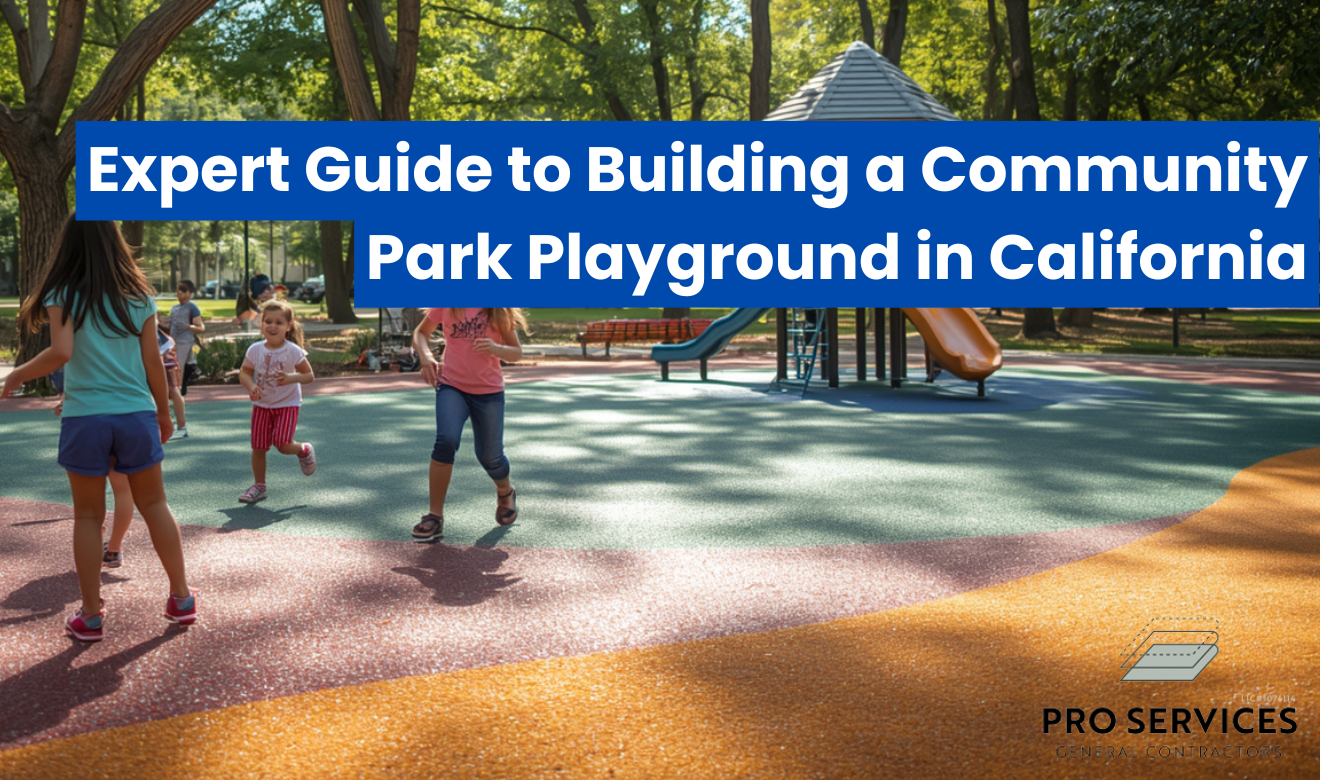
Executive Summary: Building a community park playground in California is a disciplined process that starts with defining users, standards, and site constraints, then proceeds through survey-driven design, permit-ready construction documents, quality-controlled construction sequencing, and a maintenance program that keeps the play space safe, accessible, and durable over time.
- Design to enforceable standards: Establish ASTM F1487 (equipment), ASTM F1292 (impact attenuation), and ADA/CBC accessibility as non-negotiable performance criteria and document each major decision against those requirements.
- Resolve site, drainage, and access early: Use topographic/utility due diligence and a grading-and-accessibility-focused concept plan to prevent ponding in fall zones, inaccessible routes, and late-stage redesign during plan check.
- Control quality with hold points and lifecycle planning: Sequence construction with sign-offs for subgrade, base, concrete/curbs, foundations, equipment, and surfacing, then validate performance via a pre-opening audit, post-rain drainage check, and a daily/monthly/annual maintenance matrix.
How to build a community park playground is the step-by-step process of planning, permitting, funding, constructing, and maintaining a safe public play space that meets California codes and local park standards. In California, the scope starts with site selection and a topographic and utility survey, then moves to concept design that matches the target age groups, ADA routes, and a shaded seating layout for caregivers. Typical technical deliverables include a grading and drainage plan that keeps fall zones out of ponding areas, a civil details sheet for footings, and an accessibility plan that verifies compliant slopes, landings, and clear widths from the parking stall to the play components. Safety decisions should be documented against ASTM F1487 for public playground equipment and ASTM F1292 for impact attenuation, with protective surfacing depths and test results tied to the selected fall heights. Local permitting often requires coordination with city or county Public Works, Parks, and Building divisions, plus utility marking and encroachment review when paths or staging touch a public right-of-way. Common California site realities include hard soils or expansive clays that drive deeper piers, wildfire smoke days that affect construction scheduling, and heat exposure that pushes shade structures, tree placement, and cool-to-touch surfacing choices. A realistic build plan also includes a maintenance matrix for daily, monthly, and annual inspections, replacement lead times for wear items, and a post-installation audit that verifies clearances, signage, accessible surfacing continuity, and drainage performance after the first heavy rain.
1) Define the project scope, users, and performance criteria
A successful community playground starts with a written scope that defines who will use it, what hazards must be controlled, and what standards the final installation must pass. This scope becomes the basis for design, permitting, and bid documents.
Start by documenting the operational intent (public park use, unsupervised play, daytime and weekend peak loads) and the target user groups. In California public parks, it is common to provide separate play zones for ages 2–5 and 5–12 to align with manufacturer labeling and safety layout assumptions.
- User groups and capacity: identify age ranges, expected occupancy, and any special programming (inclusive play, sensory components, nature play, fitness elements).
- Compliance baseline: confirm the project will meet ASTM F1487 (public playground equipment), ASTM F1292 (impact attenuation of surfacing), and accessibility requirements under the ADA Standards for Accessible Design (2010) as implemented through California Building Code (CBC) access provisions and any local agency standards.
- Site performance criteria: drainage (no ponding in use zones), heat mitigation (shade, cool-touch materials), wildfire smoke response plan for construction phasing, and maintainability (inspection access, replaceable wear parts).
- Risk documentation: keep a decision log tying each major safety and accessibility choice to a referenced requirement (standard section, manufacturer instructions, or plan note).
2) Select the site and complete due diligence surveys
Site selection is an engineering and operations decision, not just a space-availability decision. A proper survey package prevents utility conflicts, drainage failures, and accessibility dead-ends.
Before concept design, collect baseline information that designers and plan reviewers will require. In most California jurisdictions, a topographic survey and a utility locate are minimum starting points, and many agencies will also require geotechnical input when expansive soils or high groundwater are suspected.
- Topographic survey: map existing grades, trees, hardscape, walls, and adjacent facilities to design compliant slopes and accessible routes.
- Utility research and marking: coordinate 811 USA markings and collect as-builts from the city/county and utility providers; verify conflicts where footings and piers may land.
- Geotechnical considerations: account for expansive clays and hard soils that can drive deeper or larger diameter piers, and design for long-term settlement control.
- Environmental and operations constraints: identify irrigation coverage, protected tree root zones, lighting needs, restroom proximity, and emergency access routes.
- Red-flag site conditions: low points that pond, tight path connections that cannot meet running slope/cross slope, encroachment into the public right-of-way, and areas with recurring vandalism or poor visibility.
3) Build the concept plan around safety zones, accessibility, and caregiver comfort
A concept plan should prove three things early: safe equipment spacing, an accessible route that actually reaches play opportunities, and an adult-friendly layout that supports supervision. If any of these fail at concept stage, the project typically faces costly redesign during plan check.
Lay out play zones using manufacturer fall heights and use zones, then “wrap” the rest of the park elements around those fixed safety geometries. Provide shade and seating with clear sightlines, and locate amenities outside fall zones to avoid hazards and surfacing conflicts.
- Core layout elements:
- Separation of age groups (2–5 vs 5–12) using distance and/or barriers that do not create entrapment or protrusion hazards.
- Accessible route from parking/drop-off to the entry points of each play zone with compliant widths, slopes, and landings.
- Benches and tables placed to support supervision without blocking circulation or encroaching into use zones.
- Shade strategy: trees (with root-zone protection) and/or engineered shade structures sized to cover high-dwell locations (seating and high-heat play components).
- Heat and UV decisions to make at concept stage:
- Orient slides and high-contact components to reduce direct afternoon sun where feasible.
- Specify light-colored surfacing systems where the product line allows.
- Provide drinking fountains/bottle fillers when park standards require them and when utilities are feasible.
4) Produce the technical plan set that agencies and contractors can build from
Public agencies typically expect a plan set that resolves grading, drainage, accessibility, structural support, and construction sequencing. The plans must also align with manufacturer installation instructions and the surfacing test requirements tied to fall height.
At minimum, the construction documents should show exactly how water moves, where equipment footings are located, how accessible routes are achieved, and how the surfacing system is constructed to pass impact criteria.
- Common technical deliverables:
- Demolition and site plan: removals, limits of work, protection of existing trees and utilities.
- Grading and drainage plan: spot grades, slope arrows, drainage inlets where required, and notes preventing ponding in fall zones and accessible routes.
- Civil/structural details: equipment footing/piers per manufacturer requirements; concrete paths, curbs, and edge restraints.
- Accessibility plan: route from accessible parking and/or drop-off through the play area showing running slope, cross slope, landings, clear widths, and surface transitions.
- Surfacing plan: material extents, thickness schedule tied to fall height, edge conditions, and maintenance access points.
- Signage and amenities plan: age-range signage, rules, emergency information per local park standards, trash/recycling placement, and lighting if included.
5) Choose surfacing based on fall height, drainage, accessibility, and lifecycle maintenance
Surfacing is a life-safety system because it directly controls injury outcomes in falls and determines whether mobility devices can access play areas. Selection must be driven by ASTM F1292 results at the specified thickness for the equipment’s fall height, not by aesthetics alone.
Decisions should be recorded in the plan set: maximum fall height by component, required impact attenuation performance, thickness by zone, and how seams/edges are constructed to avoid trip hazards and water intrusion.
- Key surfacing requirements to document:
- Impact attenuation: specify compliance to ASTM F1292 for the equipment’s designated fall height.
- Equipment safety integration: coordinate use zones and surfacing extents with ASTM F1487 and manufacturer layouts.
- Accessibility: provide stable, firm, slip-resistant accessible surfaces on routes and within play components where required by the ADA Standards.
- Drainage behavior: ensure grades and underdrain strategy prevent ponding and saturation that can degrade performance.
- Lifecycle evaluation: tie selection to inspection frequency, repairability, and the ability to maintain compliant accessible transitions over time.
For parks seeking a unitary surface with clear accessible circulation and a thickness schedule matched to fall heights, Poured In Place Rubber is commonly specified because it can be detailed as a continuous system with defined edge restraints and localized thickness increases at higher fall-height zones.
If you are comparing long-term value and avoiding false savings, review why cheap surfacing costs more long term to align procurement with maintenance realities and replacement cycles.
Many agencies also require that staff and stakeholders understand common categories of playground surfacing so bid alternates and lifecycle costs are evaluated consistently.
6) Permitting and interdepartmental coordination in California
Permitting is mainly about resolving public safety, accessibility, drainage, and right-of-way impacts before construction starts. Most delays occur when civil grading, accessibility, or encroachment requirements are discovered late.
Expect coordination across Parks, Public Works/Engineering, Building, and sometimes Fire (access), plus separate reviews when work touches the public right-of-way or affects existing utilities.
- Typical agency touchpoints:
- Parks/Recreation: park standards, equipment preferences, signage, maintenance access requirements.
- Public Works/Engineering: grading/drainage, stormwater compliance triggers, utility coordination, concrete standards, and any encroachment needs.
- Building: structural aspects (shade structures, footings) and accessibility verification.
- Encroachment/right-of-way: required when staging, path tie-ins, or sidewalk work enters a public street/sidewalk corridor.
- Submittals that reduce plan-check cycles:
- Accessibility sheets with clearly called-out slopes, landings, and route widths from parking to play.
- Equipment cut sheets showing fall heights, use zones, and footing requirements.
- Surfacing product data indicating ASTM F1292 compliance at specified thicknesses.
- Construction traffic/staging plan if access impacts park operations or right-of-way.
7) Funding, procurement, and bid documents that protect quality
Funding and procurement should be structured to prevent scope gaps that become change orders, especially for surfacing thickness, drainage details, and accessibility transitions. Clear bid documents are the most reliable quality-control tool a public owner has.
In California public works contexts, align procurement with the agency’s contracting rules and ensure the specification is enforceable: submittals, mockups (when used), testing documentation, and inspection hold points.
- Write a performance-based spec: require compliance with ASTM F1487 and ASTM F1292, and require submittals demonstrating fall-height-to-thickness alignment.
- Define contractor responsibilities: utility potholing if required, protection of existing improvements, and surface protection during cure periods.
- Include quality checkpoints: pre-install meeting, subgrade acceptance, base acceptance, and post-install walkthrough for clearances and accessible continuity.
- Require closeout deliverables: as-builts, product data, maintenance instructions, and warranty documents.
8) Construction sequencing that prevents rework and safety defects
The build sequence should prioritize underground work, drainage correctness, and proof of accessible grades before play equipment and surfacing go in. Most expensive rework happens when slopes and drainage are “discovered” after the surface is installed.
Use a hold-point approach where the owner or inspector signs off on each layer: subgrade, base, concrete/curbs, equipment foundations, then surfacing and final audit.
- Typical sequence:
- Mobilization, fencing, tree protection, and utility verification/potholing as required.
- Rough grading and installation of drainage features (and underdrains if designed).
- Concrete flatwork and edge restraints; verify slopes and landings on accessible routes.
- Equipment footings/piers installed per manufacturer instructions; allow cure time.
- Equipment assembly and verification of use zones and clearances.
- Surfacing installation at specified thickness by fall height; protect during cure.
- Punch list, signage installation, and final cleaning/opening coordination.
- California scheduling realities to plan for:
- Heat waves: adjust work hours and curing protection to reduce defects.
- Wildfire smoke days: plan contingencies for outdoor labor and material deliveries.
- Rainy season: ensure temporary erosion and sediment controls where needed and keep staging out of muddy access routes that track sediment onto fresh surfaces.
9) Inspection, documentation, and post-installation audit
A post-installation audit verifies that the playground you designed is the playground you built, with no hidden hazards or accessibility breaks. This audit should occur before opening and again after the first major rain to confirm drainage performance.
At a minimum, confirm equipment clearances, surfacing continuity, signage, and accessible routes from arrival points to play activities.
- Pre-opening checks:
- Verify installed equipment matches the approved layout and manufacturer instructions.
- Confirm use zones are unobstructed and that amenities (benches, trash cans, boulders) did not drift into fall zones.
- Check accessible route continuity: no abrupt level changes, excessive cross slope, or pinch points.
- Review surfacing installation quality: seams, edges, transitions, and drainage behavior.
- Confirm age-range signage and rules signage match local park standards.
- After-first-rain verification:
- No standing water within fall zones or on accessible routes.
- No erosion at edges, no undermining at curbs, and no settlement that creates trip hazards.
10) Maintenance matrix: daily, monthly, and annual tasks
Long-term safety depends on a written inspection program with defined frequencies and responsibility assignments. A maintenance matrix also helps agencies justify budgets by tying labor and replacement parts to risk reduction.
Use a tiered schedule that separates quick visual checks from detailed condition assessments and planned replacement of wear components.
- Daily / routine (high-level visual):
- Remove trash, sharp objects, and vandalism hazards.
- Check for obvious trip hazards, loose components, or exposed footings/edges.
- Verify gates/latches (if fenced) and that signage remains legible.
- Monthly (operational inspection):
- Check fasteners, moving parts, and wear points per manufacturer guidance.
- Inspect surfacing for cracks, seam separation, edge curl, and drainage issues.
- Confirm accessible routes remain stable and free of differential settlement.
- Annual (comprehensive):
- Full audit against current equipment layout, use zones, and documented standards.
- Plan replacement of high-wear items with realistic lead times (hardware kits, swing seats, bearings, and surfacing repairs).
- Review incidents and adjust site features (shade, seating, sightlines, or circulation) where recurring issues occur.
Key specifications and local compliance checkpoints (California)
This table condenses the build requirements into a plan-check and construction punch list format. Use it to verify that design decisions are tied to enforceable standards and local review expectations.
| Feature / Metric | Specifications | Local Guidelines |
|---|---|---|
| Equipment safety standard | ASTM F1487 compliance for public playground equipment; use zones and fall heights per manufacturer documentation | Plan reviewers commonly require cut sheets and a layout showing use zones; separate age areas are typically expected where feasible |
| Impact attenuation (surfacing) | ASTM F1292 performance tied to the equipment’s designated fall height; thickness schedule shown on plans | Agency acceptance often depends on submittals that link fall height → required thickness; avoid ponding and edge failures that degrade performance |
| Accessible routes to play | Accessible path from arrival (parking/drop-off) to play components per ADA Standards for Accessible Design (2010) and CBC access provisions as applicable | Cities/counties often require an explicit accessibility plan sheet with slopes, landings, widths, and surface transition details |
| Grading and drainage | No ponding in fall zones; drainage directed away from surfacing edges; subgrade/base designed to support surface system | Public Works typically reviews grading, drainage, and any tie-ins to existing facilities; post-rain verification is a best practice |
| Footings and soil response | Footings/piers per equipment manufacturer requirements; geotechnical recommendations applied where expansive soils or hard soils exist | Expansive clays are common in parts of California and can require deeper piers; document assumptions in plans and details |
| Right-of-way and encroachment | Encroachment review/permit when construction, staging, or path work affects sidewalks/streets | Coordinate early with Public Works; include traffic control and restoration notes where required |
Build it once, keep it safe: the operating-ready playground checklist
The final step is ensuring the playground is not only constructed, but operationally ready with enforceable documentation and a funded maintenance plan. When scope, standards, drainage, and accessibility are verified as a system, the park can open with confidence and remain compliant over time.
- Before opening day: signed inspections/acceptance, verified accessible route continuity, confirmed surfacing install quality, and installed signage.
- Within the first season of use: complete a post-rain drainage review, adjust maintenance frequencies based on observed wear, and document any needed corrective work.
- Annually: re-audit safety zones, surfacing condition, and accessible connections to keep the play environment aligned with ASTM performance expectations and ADA/CBC access requirements.
Frequently Asked Questions
Don’t Let “Good Enough” Planning Turn Into a Liability After Opening Day
Building a community park playground in California isn’t just picking equipment and pouring concrete—it’s a chain of decisions that have to survive plan check, inspections, real-world weather, and years of public use. When the scope, grading, drainage, accessible routes, and impact-attenuating surfacing aren’t engineered and coordinated correctly, the consequences show up fast: standing water in fall zones, failed accessibility continuity, premature surfacing breakdown, rejected inspections, delayed openings, budget-draining change orders, and worst of all—avoidable injuries that put your agency, HOA, or organization directly in the crosshairs.
The risky part? These problems often don’t appear on paper. They show up when the first heavy rain hits, when heat stress warps schedules and cure times, when expansive soils shift, or when an “almost compliant” accessible route becomes a real barrier for families who rely on it. And once surfacing is installed, fixing slopes, drainage paths, edge restraints, and thickness schedules is rarely a simple patch—it’s demolition, rework, and reputational damage.
If you want the playground to pass the first time and stay safe long after the ribbon cutting, you need a local specialist who understands California permitting expectations, ASTM performance requirements, and the realities of building durable, accessible surfacing that holds up to public use. Get the planning, detailing, and installation guidance you need now—before small misses become expensive problems.
Related Posts

The Ultimate Guide to Rubber Playground Flooring in San Diego, California
Executive Summary Rubber playground flooring San Diego performs best when it is specified and installed…

Top Quality Rubber Playground Flooring Options in Orange County, California
Executive Summary Rubber playground flooring in Orange County performs best when specified and built as…
Leave a Reply