
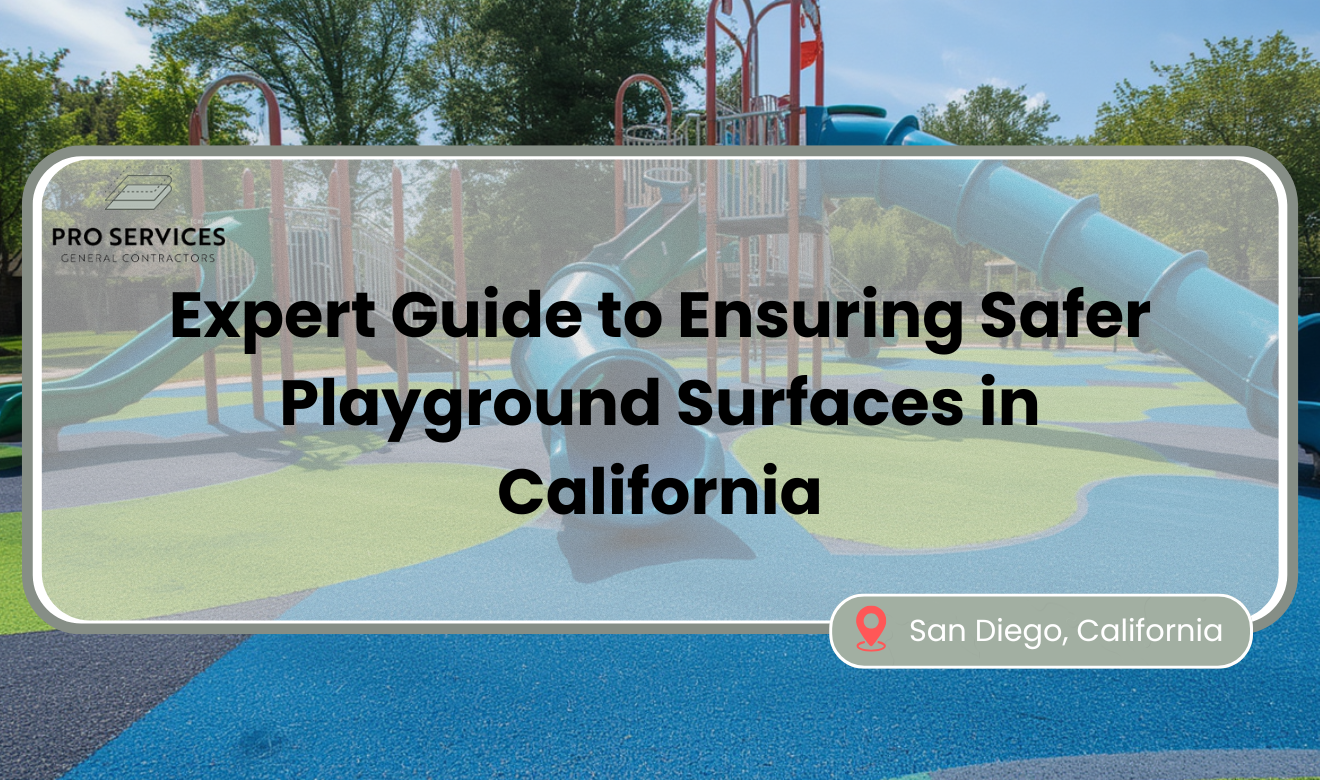
Expert Guide to Ensuring Safer Playground Surfaces in California
Executive Summary
Make a playground surface safer by specifying impact-attenuating surfacing that meets ASTM F1292 at the site’s maximum accessible fall height, extending it through correct fall/use zones, and maintaining it so it never degrades into thin spots, hard spots, seam failures, or exposed base. For California sites, pair this with ASTM F1951 where accessible routes are required, align layout with CPSC/ADA guidance, and adjust specifications for local drainage, coastal corrosion, and inland heat/UV.
Core Insights
- Design to Verified Fall Protection: Determine the tallest accessible fall height and require installed-condition ASTM F1292 compliance (HIC/G-max) for the full surface system, not just product data sheets.
- Build a Real Fall/Use Zone Plan: Extend impact surfacing at least 6 feet around stationary equipment and expand use zones for swings, slides, and high-traffic exit/entry paths per CPSC and manufacturer layouts.
- Maintain to Prevent Predictable Failures: Use surface-type inspection triggers (EWF depth loss, PIP seam/edge shrinkage, turf infill/pad discontinuities) plus post-storm checks to fix hazards before reopening.
How to make a playground surface safer means selecting and maintaining impact-attenuating surfacing that meets ASTM performance thresholds for the equipment’s fall height and stays compliant with California safety expectations. In California, start by matching surfacing depth and tested critical fall height to the tallest accessible platform. Use a site-specific fall zone plan. Extend surfacing at least 6 feet in all directions from stationary equipment. Increase the zone for swings and slides based on use zones. Specify ASTM F1292-compliant impact testing for installed surfacing. Require ASTM F1951 accessibility where an accessible route is needed. Confirm the surface is firm, stable, and slip resistant under typical local conditions. In coastal areas like the Bay or San Diego, prioritize drainage and corrosion-resistant edging to prevent standing water and undermining. In Central Valley heat, check surface temperatures and add shade where feasible. For engineered wood fiber, rake and top off to maintain the required compacted depth, especially under slide exits and swing bays. For poured-in-place rubber, inspect seams, shrinkage, and UV brittleness, and repair trip edges immediately. For turf systems, verify infill depth and shock pad continuity, and check for exposed base at high-wear paths. Document routine inspections and post-storm checks, and correct displacement, contamination, and hard spots before reopening high-use zones.
Start With the Safety Framework California Sites Are Expected to Follow
Safer playground surfacing starts with adopting the same technical standards used by inspectors, manufacturers, and public agencies: ASTM for impact and accessibility, and CPSC/ADA guidance for layout and use zones. The fastest way to reduce injury risk is to match the surface’s tested fall protection to the equipment’s maximum accessible fall height and keep it that way over time.
For California projects, the core reference set typically includes:
- ASTM F1292 (impact attenuation for playground surfacing) — requires testing and reporting using Head Injury Criterion (HIC) and G-max for a given drop height.
- ASTM F1951 (accessibility performance for playground surfaces) — establishes a test method for wheelchair maneuverability on the surface along accessible routes.
- CPSC Public Playground Safety Handbook — widely used for fall zones, equipment layout, and hazard reduction practices.
- 2010 ADA Standards for Accessible Design — governs accessible routes, slopes, and clearances when a route to play components is required.
Understanding playground surfacing as a system (surface + base + drainage + maintenance) prevents the most common failure: a surface that tested well once, then hardened, thinned, or separated in high-wear areas.
Measure Fall Height Correctly Before You Specify Any Surface
All impact-attenuating surfacing decisions are driven by one number: the equipment’s maximum accessible fall height. If fall height is underestimated, even “soft” surfaces can fail injury criteria at real-world drop points.
Use these steps to determine the correct target:
- Identify the highest accessible play surface (platform, rung, or deck a child can stand on).
- Use the manufacturer’s documentation for designated fall height when available; verify in-field if equipment has been modified.
- Confirm surfacing thickness is designed to meet ASTM F1292 at or above that fall height for the chosen system (loose-fill, unitary rubber, or synthetic turf with pad).
Practical rule for safer outcomes: specify surfacing for the tallest accessible height on-site, not the average height, and do not “value engineer” thickness in exchange for decorative finishes.
Build a Site-Specific Fall Zone Plan (Not a Generic 6-Foot Ring)
Every surfacing plan must map fall zones and use zones to actual equipment type, motion, and entry/exit points. While “6 feet around equipment” is a baseline for many components, swings, slides, and circulation paths routinely require more.
At minimum, design the surfacing footprint to include:
- Stationary equipment: extend impact-attenuating surfacing at least 6 feet in all directions (a common CPSC baseline), and increase where overlapping components or access points create higher fall likelihood.
- Swings: use zones must extend forward and back beyond the pivot point; design per the swing bay’s configuration and CPSC guidance.
- Slides: provide enhanced attention at slide exit regions (a high-impact, high-wear zone) where loose-fill displacement and unitary seam damage are most common.
- Accessibility routes: ensure compliant routes connect to required play components with surfaces that satisfy firmness/stability expectations and can meet ASTM F1951 where applicable.
Document the fall zone plan as part of closeout so maintenance teams can restore depths and boundaries accurately after storms, heavy use, or repairs.
Require Installed-Condition ASTM F1292 Compliance—Not Just Product Data Sheets
Product brochures are not a substitute for installed performance, because base prep, drainage, compaction, and wear all change impact results. The safest specification language requires proof that the installed surface system meets ASTM F1292 for the project’s fall height.
Strengthen your scope and procurement by requiring:
- ASTM F1292 testing documentation that corresponds to the specified system build-up (surface + pad/base) and the target fall height.
- Field verification where appropriate, especially for high-liability sites (schools, municipal parks, childcare facilities).
- Warranty terms that do not exclude common failure points like seams, shrinkage, edge curl, and localized wear at entrances/exits.
When an accessible route to play components is required, incorporate ASTM F1951 performance for the route surface (and verify transitions, slopes, and turning areas are consistent with ADA expectations).
Use This Comparison Table to Select Surfacing That Stays Safe Over Time
The safest surface is the one that meets impact criteria at the required fall height and remains consistent under weather, wear, and maintenance realities. This table summarizes what to specify and what to enforce on California jobs.
| Feature / Metric | Specifications | Local Guidelines |
|---|---|---|
| Impact performance (critical fall height) | Specify ASTM F1292 compliance for the equipment’s maximum accessible fall height; keep HIC/G-max reporting with closeout documents. | Common in CA public procurements to require documentation aligned to installed system (surface + base), not just product literature. |
| Use zone footprint | Stationary equipment typically requires ≥6 ft perimeter; swings and slides require expanded use zones per CPSC guidance and manufacturer layout. | Plan for high-use parks and schools with enlarged wear areas at circulation paths, slide exits, and swing bays. |
| Accessibility performance (routes) | Where an accessible route is required, specify ASTM F1951 for the route surface; manage transitions to avoid vertical changes and trip edges. | Align route layout and slopes with 2010 ADA Standards; avoid loose-fill on primary accessible routes unless mitigated with compliant systems. |
| Drainage & base stability | Require positive drainage away from play areas; base must resist pumping, settlement, and erosion that create hard spots. | Coastal CA sites should prioritize drainage layers and corrosion-resistant edging to limit standing water and undermining. |
| Maintenance triggers | Define measurable conditions: displaced loose-fill below target depth, exposed base, seam separation, edge curl, cracking, or hardened areas. | Add post-storm inspections and rapid repairs before reopening high-use zones; document corrective actions. |
Control the “Real-World” Failure Modes That Make Surfaces Unsafe
Most surfacing injuries occur because the surface changed after installation—depth loss, seam damage, hardening, or exposed base—rather than because the original product was wrong. A safer playground surface program targets predictable failure points and assigns clear inspection actions.
Focus on these high-frequency problems:
- Loose-fill displacement under swings, at slide exits, and along desire paths.
- Hard spots from compaction, contamination, or base migration.
- Trip edges at surfacing transitions, borders, and repairs.
- Drainage failures that cause erosion, pumping, or standing water (which accelerates surfacing breakdown).
- Heat and UV exposure leading to brittleness, shrinkage, or uncomfortable surface temperatures.
One cost-control strategy that also improves safety is choosing systems with predictable maintenance and repair pathways; long-term lifecycle decisions often outperform “lowest bid” installs. For a deeper discussion of lifecycle cost and performance tradeoffs, see why cheap surfacing costs more long-term.
Maintenance Protocols by Surface Type (What to Inspect and What to Fix)
Each surfacing type has specific inspection points that correlate to injury risk. If you standardize these checks and require documented corrective action thresholds, you prevent most compliance failures before they become incidents.
Engineered Wood Fiber (EWF)
EWF is only protective when the compacted depth remains at the level needed for the equipment fall height and when drainage prevents saturation and decay. Your daily/weekly work is depth control in the wear zones.
- Rake and re-distribute fiber back into swing bays and slide exits (high displacement zones).
- Top off material when compacted depth drops below the specified requirement for the tallest accessible fall height.
- Remove contamination (trash, glass, organic debris, animal waste) immediately and replace affected material.
- Inspect borders and containment so fiber cannot migrate onto sidewalks (slip/trip hazard) and so accessible routes remain functional.
Poured-in-Place (PIP) Rubber
PIP rubber offers consistent fall protection when the installed thickness, seams, and edges remain intact and the base stays stable. Safety depends on preventing trip hazards and correcting localized wear before it exposes the base layer.
- Inspect seams and transitions for separation, curl, or height differences that create trips.
- Check for shrinkage and edge pullback at borders, footings, and penetrations.
- Evaluate surface brittleness (UV aging) and cracking; repair promptly to prevent water intrusion and delamination.
- Verify drainage performance after storms; persistent ponding can accelerate adhesive failure and base movement.
If your site needs a unitary surface that supports accessibility and simplifies depth control compared with loose-fill, consider Poured In Place Rubber as an option to evaluate alongside turf + pad systems and loose-fill.
Synthetic Turf Systems (Play Turf + Shock Pad/Infill)
Turf systems stay safer when infill depth, pad continuity, and seams remain consistent in the fall zone. The most dangerous turf failures are exposed base, seam openings, and infill loss that reduces impact attenuation.
- Verify infill depth in high-wear paths, under swings, and at slide exits; redistribute and replenish per the system requirements.
- Confirm shock pad continuity (no gaps, curled sections, or displaced panels) and repair transitions immediately.
- Check seams for separation and trip edges; address before edges fray and widen.
- Look for exposed base at entries, corners, and under moving equipment zones; close the area until repaired.
California Climate & Site Conditions That Should Change Your Specification
Local climate conditions directly affect traction, temperature, drainage, and material aging—each of which influences injury risk and compliance. A safer surface spec accounts for coastal moisture, inland heat, and storm-driven erosion patterns.
Apply these California-specific adjustments:
- Coastal zones (Bay Area, San Diego coastal influence):
- Prioritize rapid drainage and prevent standing water that undermines bases.
- Use corrosion-resistant edging and anchoring where metal components are exposed to salt air.
- Increase frequency of inspections after heavy fog/dew cycles that can increase slipperiness on certain finishes.
- Inland heat (Central Valley and hot inland valleys):
- Evaluate surface temperature risk during peak heat; add shade where feasible to reduce contact-burn risk and extend material life.
- Watch for UV-driven brittleness in unitary surfaces and seam adhesive fatigue in turf systems.
- Storm events statewide:
- Perform post-storm inspections for erosion, displacement, ponding, and sediment contamination.
- Re-open only after correcting hard spots, trip edges, and exposed base within the fall/use zones.
Inspection Documentation: What to Record So You Can Defend Safety Decisions
Written inspection records are a safety tool and a risk-management requirement for many operators because they show hazards were identified and corrected within a defined process. The most defensible system is simple, routine, and tied to measurable thresholds.
Use a log that captures:
- Date/time, inspector name, and weather conditions (especially after rain or extreme heat).
- Surface condition by zone: under swings, slide exits, high-traffic paths, and perimeters.
- Defects observed: seam separation, cracking, displacement, contamination, ponding, exposed base, or trip edges.
- Immediate controls: barricades, signage, or temporary closure of the affected component/use zone.
- Corrective action and re-inspection confirmation before reopening.
Operationally, many sites adopt a cadence similar to: routine visual checks (often daily in busy parks/schools), formal weekly condition checks, and event-driven inspections after storms or reported incidents.
Safety Wrap-Up: A Practical Checklist That Keeps Surfaces Compliant and Protective
Making a playground surface safer is a repeatable process: specify to the correct fall height, build the correct use zones, verify ASTM performance, and maintain the surface so it never degrades into hard spots, thin areas, or trip hazards. When you treat surfacing as a system (material + base + drainage + documentation), you materially reduce serious head-injury risk and improve accessibility outcomes.
- Confirm maximum accessible fall height and design surfacing to meet it under ASTM F1292.
- Draw a site-specific fall/use zone plan (not just a generic perimeter), expanding for swings/slides and traffic paths.
- Address accessibility with ADA-consistent routes and ASTM F1951 where required.
- Design for local climate: drainage and corrosion resistance near the coast; heat/UV and shade strategies inland.
- Maintain by surface type: top off/rake EWF, repair seams/edges on unitary surfaces, restore infill/pad continuity on turf.
- Document inspections and repairs and correct hazards before reopening high-use zones.
Frequently Asked Questions
Don’t “Set It and Forget It” Your Playground Surfacing—Get It Verified, Compliant, and Maintained
If your playground surfacing isn’t matched to the correct fall height, installed to the right build-up, and maintained where kids actually land, you’re not just dealing with wear and tear—you’re dealing with preventable injuries, failed inspections, and liability exposure that can shut down your play area fast.
Here’s the hard truth: most surfacing problems don’t show up on day one. They show up after the first heavy-use week, the first storm, the first heat wave, or the first time loose-fill migrates from swing bays and slide exits. Suddenly you’ve got thin spots, hard spots, exposed base, seam separation, trip edges, ponding water, and an accessibility route that no longer performs the way it’s expected to. And once those issues exist, “quick fixes” often make things worse—because the real causes are usually in the base, drainage, transitions, containment, and the way the surface was specified in the first place.
Trying to manage this without an experienced local expert is where operators get burned: relying on product data sheets instead of installed-condition ASTM F1292 performance, guessing at fall heights, using generic use zones that don’t fit swings and slides, or overlooking California-specific demands like coastal drainage/corrosion and inland heat/UV stress. The result is expensive rework, documentation gaps, and unsafe conditions that can’t be defended after an incident.
If you want a surface that actually stays safe—not just looks finished—get a site-specific plan, correct use zones, ASTM-aligned performance expectations, and a maintenance approach that prevents the predictable failure modes before they turn into closures.
Related Posts

Expert Guide to Choosing the Best Rubber Playground Surface in San Diego, California
Executive Summary A rubber playground surface in San Diego is “safe” and durable only when…

The Ultimate Guide to Choosing Rubber Playground Surfaces in Orange County, California
A rubber playground surface in Orange County should be selected and accepted based on documented,…
Leave a Reply