Key Takeaways
PIP playground installation San Diego projects perform best when permits/review triggers, equipment layout, fall heights, and base/drainage conditions are confirmed before surfacing crews mobilize. Because poured-in-place rubber is a system (base, drainage, layers, transitions, and maintenance), durability and accessibility depend on following manufacturer instructions and planning verification steps at turnover.
- Permits and plan review triggers: You may need a permit or formal review when work includes new equipment, grading, drainage changes, concrete flatwork, footings, shade structures, or ADA route modifications, and requirements can vary by whether the site is a park, school, public facility, right-of-way, or private commercial property.
- Safety and thickness are layout-dependent: PIP thickness is typically selected to match each play component’s critical fall height using the surfacing system’s tested documentation, so different areas can require different thicknesses and transitions must be planned to avoid trip edges and weak points.
- Base prep, drainage, and weather control outcomes: A stable, properly sloped asphalt or concrete base with reliable drainage—and moisture limits that meet the manufacturer’s requirements—helps reduce bubbling, delamination, cracking, and ponding that can undermine both durability and real-world ADA usability.
PIP playground installation San Diego typically requires planning for permits, code compliance, and safety standards before any surfacing or equipment is set in place. In California, playground projects commonly need to align with ASTM F1487 for public playground equipment and ASTM F1292 for impact attenuation, along with ADA accessibility considerations for routes, transfer systems, and surfacing.
In San Diego, permitting and site requirements can vary based on whether the playground is in a public right-of-way, a park, a school campus, or a private commercial property, and factors like grading, drainage, and fall zones can affect both design and total cost. Proper documentation, manufacturer instructions, and inspection planning help reduce rework and support long-term safety.
This guide breaks down what to expect for permits, safety and accessibility benchmarks, budget drivers (including surfacing and site prep), and how to evaluate contractors based on experience, installation methods, and verification steps that support compliant, durable installations.
What “PIP Playground Installation” Means (and Why It’s Popular in San Diego)
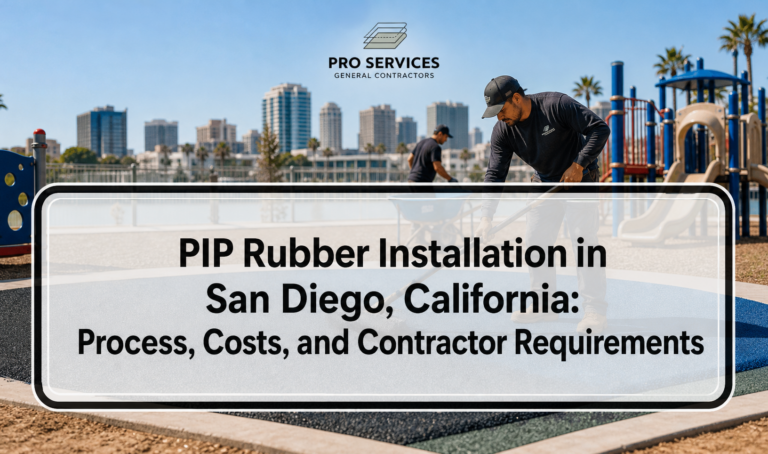
PIP playground installation San Diego projects typically refer to poured-in-place (PIP) rubber surfacing installed as a seamless, impact-attenuating play surface under and around playground equipment. It’s commonly chosen for accessibility, drainage options, and design flexibility when installed over a properly built base.
PIP rubber is usually installed in two layers: a shock-absorbing base layer (often made with recycled rubber) and a colored wear layer (often EPDM or similar). The finished system is only as reliable as the underlying base, drainage plan, and the installer’s mixing, troweling, and cure controls. Because San Diego sites can range from coastal moisture to inland heat, contractors typically plan for weather windows, substrate temperatures, and cure times to reduce defects such as cracking, bubbling, or premature wear.
When you’re comparing surfaces, it helps to separate two different goals: accessibility (smooth, stable routes) and injury reduction (impact attenuation). PIP is often used because it can address both—when thickness is matched to the equipment’s fall height and the surface is installed to the manufacturer’s specifications.
Permits, Plan Review, and Site Triggers in San Diego
Permitting needs depend on the property type and scope, but most playground builds require some level of documentation for layout, accessibility, and safety surfacing. The earlier you confirm permitting triggers, the fewer redesigns you’ll face after equipment or surfacing is ordered.
For PIP playground installation San Diego projects, permitting can become necessary due to grading, drainage changes, new concrete curbs, shade structures, retaining walls, or any work that affects accessible routes. Sites in parks, schools, or public facilities may also require additional stakeholder reviews (risk management, maintenance, and inspections) even when a traditional building permit is not required.
Common reasons a playground project gets flagged for review
Even “surface-only” renovations can require review if they change elevations, drainage, or accessibility routes. Treat these items as early checklist points with your designer or contractor.
- New playground equipment installation, replacement, or relocation
- Subgrade work, grading, or importing/exporting soil
- Drainage modifications (area drains, trench drains, connecting to storm systems)
- Concrete flatwork, curbs, ramps, or steps affecting accessible paths
- Work near utilities, irrigation mains, or electrical for lighting
- Installation of shade structures or site furnishings requiring footings
Documents that reduce rework
Plan sets and submittals vary by agency and owner, but consistent documentation helps reviewers confirm fall zones, slopes, and surfacing performance. It also helps installers avoid change orders caused by missing dimensions or unclear scope.
- Scaled site plan showing equipment footprints, use zones, and circulation paths
- Surfacing plan showing PIP thickness by fall height (per the system’s test documentation)
- Base specification (asphalt or concrete thickness, compaction targets, drainage approach)
- ADA route and entry points, including transitions at curbs and borders
- Manufacturer installation instructions for both equipment and surfacing
- Inspection and punch-list plan (who signs off and when)
Safety Standards That Commonly Drive PIP Design
Most public-facing playgrounds are designed around recognized standards for equipment safety and impact attenuation. Rather than treating standards as “paperwork,” use them as design inputs that directly affect thickness, layout, and long-term performance.
Two standards frequently referenced in the U.S. for playgrounds are ASTM F1487 (public playground equipment) and ASTM F1292 (impact attenuation for surfacing). These standards don’t “approve” a playground by themselves, but they provide test methods and performance benchmarks that designers, owners, and inspectors use to evaluate risk. If your site is a school, park, or other public setting, it’s typical to plan inspections and documentation around these frameworks.
Critical fall height and why surfacing thickness isn’t “one size fits all”
Surfacing thickness is commonly tied to the equipment’s critical fall height and the specific PIP system’s tested performance. Rely on the surfacing manufacturer’s documentation and the actual equipment layout rather than assuming a standard thickness will work everywhere.
- Different play components can have different fall heights within the same playground.
- Transitions between thicknesses must be planned to avoid trip edges and weak points.
- Swings, climbers, and rotating equipment often require special attention due to motion and use patterns.
Because impact performance can change over time with wear, UV exposure, and maintenance, owners often plan periodic condition checks. If your project requires verification, discuss whether field testing, installer QA logs, or third-party inspection reports will be used to document compliance at turnover.
ADA Accessibility: Routes, Edges, and Real-World Usability
Accessible play isn’t just about having an accessible gate; it’s also about routes, entry points, and how the surface behaves over time. PIP is often selected because it can provide a continuous, firm surface when properly installed and maintained.
ADA considerations typically touch multiple parts of a playground build: accessible routes from parking or drop-off, slopes, turning space, transitions, and usable access to play components. Even if your project is on private property, many owners still aim to meet accessibility best practices because it reduces barriers for children, caregivers, and staff.
Practical ADA-focused details that affect PIP installations
Small design decisions—like how you handle borders and drainage—can make the difference between a surface that remains accessible and one that becomes difficult to navigate.
- Transitions: Minimize abrupt edges between sidewalks, curbs, and the PIP field.
- Slopes: Keep slopes within tolerances required for accessible routes; coordinate grading before surfacing.
- Drainage: Prevent ponding that can degrade binders and create slippery areas.
- Wear paths: Plan for higher traffic at entries, slides, and popular components—these areas may need reinforcement details or more frequent inspections.
Base Prep and Drainage: The Biggest Determinants of Durability
PIP failures are often rooted in substrate problems rather than the rubber itself. A well-designed base, correct slopes, and controlled moisture conditions are essential for a durable installation.
PIP is commonly installed over asphalt or concrete. Both can work, but each has trade-offs related to cracking, drainage, and repairs. In San Diego, it’s also common to coordinate irrigation adjustments and drainage improvements during playground renovations so water doesn’t migrate under the system or collect in low spots.
Typical base options (and what to watch)
Choosing a base is often a mix of performance needs, schedule, and existing site conditions. The best choice is usually the one that matches the site’s drainage and long-term maintenance plan.
- Asphalt base: Often used for playground surfacing; can be shaped to slope and drains. Watch for cracking and require proper compaction and thickness.
- Concrete base: Can be stable when properly built with joints; repairs can be more involved. Ensure slope and drainage are correct to avoid standing water.
Drainage and moisture control checklist
Moisture is one of the most common contributors to adhesion and cure issues. Drainage planning should be confirmed before surfacing mobilizes.
- Confirm surface slopes and drainage flow lines on the base.
- Identify irrigation overspray zones and adjust heads as needed.
- Verify drain inlets, cleanouts, and elevations won’t create trip hazards at transitions.
- Schedule surfacing when rain risk is low and substrate moisture is within the manufacturer’s requirements.
PIP Rubber vs. Other Playground Surfacing Options
Surfacing selection comes down to accessibility goals, maintenance capacity, budget, and how the space is used. Comparing options side-by-side helps clarify what you gain (and what you take on) with PIP.
| Surfacing Option | Key Considerations | Best-Fit Scenarios in San Diego |
|---|---|---|
| Poured-in-place (PIP) rubber | Seamless surface; thickness can be varied by fall height; quality depends heavily on base prep, mixing, weather, and installer skill. | Parks, schools, HOAs, and civic sites prioritizing accessibility and a unitary surface; projects where graphics or defined play zones are desired. |
| Rubber tiles | Modular replacement can be easier; seams and edge lifting can occur; subbase flatness is critical. | Smaller play areas or sites needing modular repairs; some rooftop/deck applications when engineered for the assembly. |
| Engineered wood fiber (EWF) | Lower upfront cost in some cases; requires ongoing raking/top-offs; accessibility can degrade without maintenance. | Budget-sensitive projects with dedicated maintenance staff and clear replenishment plans. |
| Loose-fill rubber mulch | Can migrate; requires borders and regular grooming; accessibility can vary with compaction and displacement. | Sites with contained play zones and the ability to frequently maintain depth and distribution. |
| Synthetic turf (playground systems) | System performance depends on turf, pad, infill, drainage, and seams; requires grooming and hygiene planning. | Playgrounds that want a “green” aesthetic and multi-use programming; projects already planning turf in adjacent landscapes. |
If you want a deeper discussion of long-term budgeting trade-offs (especially where lower upfront bids create higher lifecycle cost), review why cheap surfacing can cost more long-term.
Budget Drivers: What Moves the Price Up or Down
PIP budgets are mostly driven by site prep, base condition, thickness requirements, and detailing complexity. Focusing on the major cost levers early helps you avoid redesigns and change orders.
It’s rarely just the rubber. Demolition, grading, asphalt/concrete work, drainage, and ADA transitions can exceed the surfacing line item—especially on older sites with unknown conditions. Colors, graphics, and complex geometry can also increase labor time because PIP is installed by hand troweling and requires careful timing.
Common scope elements that affect cost
Use this list to structure bids so you can compare contractors more accurately. When bids aren’t apples-to-apples, the “low” number often excludes critical prep.
- Demolition and disposal (existing surfacing, curbs, concrete, or equipment footings)
- Base replacement versus overlay (and crack repairs if overlaying)
- Drainage additions or re-grading to correct ponding
- PIP thickness variation across the playground (tied to fall height requirements)
- Edge details at sidewalks, curbs, ramps, and equipment borders
- Color blends, patterns, logos, and inlaid graphics
- Protection of surrounding improvements (landscape, fences, irrigation, nearby hardscape)
How to Vet Contractors for PIP Playground Installation in San Diego
The installer’s process controls matter as much as the product. A strong contractor can explain substrate requirements, weather limitations, QA steps, and how they handle repairs and punch lists.
PIP is sensitive to mixing ratios, binder handling, temperature, humidity, and timing. That’s why contractor selection should be based on documented methods—not just photos. If you’re an HOA, school, or municipality, it’s reasonable to ask bidders how they verify thickness, manage seams, and coordinate with playground equipment installers.
Bid and preconstruction questions that reveal competency
These questions help you find out whether a contractor is planning for compliance and durability—or simply quoting square footage.
- How will thickness be confirmed by area, especially where fall heights differ?
- What base repairs are included (cracks, spalls, birdbaths/low spots), and what’s excluded?
- What weather and substrate moisture conditions stop installation?
- How will seams be planned to reduce visible joint lines and weak points?
- What cure time is required before reopening, and how will the area be protected?
- What closeout documentation will be provided (product data, care instructions, warranty info if offered by manufacturer/installer, as applicable)?
Verification steps that help owners and inspectors
Verification doesn’t have to be complicated, but it should be planned. Agree on who documents what before the crew arrives onsite.
- Confirm final equipment layout and use zones before surfacing begins.
- Review surfacing system documentation for the specified fall heights.
- Conduct a pre-pour walk with the installer to confirm base readiness and drain behavior.
- Schedule inspections or punch walks after cure and before opening to the public.
Related Improvements Often Bundled with PIP Installations
Many playground renovations bundle surfacing with adjacent scope like splash pads, shade, and site amenities. Bundling can reduce downtime and helps ensure transitions and drainage are coordinated.
If your site includes water features, consider how wet zones affect traction, drainage, and cleaning routines. Similarly, shade structures can protect users and reduce heat gain on the surface, but they can also introduce new footings and permitting requirements. Coordination is key: it’s easier to set footings, sleeves, and borders before the surfacing is installed than to cut and patch afterward.
- Shade structures and seating areas
- Border and curb replacements to improve accessible transitions
- Drainage upgrades and irrigation corrections
- Water play areas and transitions between wet/dry zones
For owners who want a seamless unitary surface from the equipment area through surrounding paths, poured in place rubber is often specified to maintain continuity and reduce trip edges.
Maintenance Planning: Protecting Performance Over Time
PIP surfaces are not maintenance-free; they’re maintenance-light when cared for consistently. A simple plan for cleaning, inspections, and minor repairs can extend service life and reduce safety risks.
Maintenance needs vary based on shade, nearby trees, sand/dirt exposure, and how heavily the playground is used. In coastal San Diego, airborne salt and moisture can increase cleaning needs, while inland sites may see more UV and heat stress. Either way, the goal is to keep the surface clean, bonded, and free of trip hazards.
Baseline maintenance actions many owners adopt
Always follow the surfacing manufacturer’s care instructions, especially regarding cleaning chemicals and pressure washing. If you don’t have those instructions, request them as part of closeout.
- Weekly or monthly debris removal (leaves, sand, and litter)
- Spot cleaning for spills, gum, or organic staining before it sets
- Routine checks for edge separation, cracks, or localized wear
- Prompt patching of small defects to prevent water intrusion and delamination
If you want a general primer on playground surfacing categories and how they’re commonly described, you can review playground surfacing as a starting point, then align your final choices with the manufacturer’s tested system documentation and your site’s inspection requirements.
Planning Your Next Steps for a Compliant, Durable Playground Build
The most reliable results come from aligning permits, layout, base prep, and verification before surfacing crews mobilize. Treat PIP as a system—base, drainage, rubber layers, transitions, and maintenance—rather than a finish applied at the end.
To move from concept to construction with fewer surprises, start by confirming where the playground sits (public park, school, HOA, or commercial property), then validate the required documentation for safety and accessibility. From there, ensure the surfacing thickness plan matches the equipment’s fall heights and that the base is designed to drain and resist cracking. When those fundamentals are handled early, PIP playground installation San Diego projects are much more likely to meet inspection expectations and perform well over time.
Frequently Asked Questions
Get Clear on Permits, Fall Heights, and Base Prep Before You Pour
If you’re planning a poured-in-place (PIP) playground surfacing project in San Diego, a quick review of your site conditions and documentation can prevent common setbacks—like thickness mismatches, drainage issues, or accessibility transitions that trigger revisions after materials are ordered.
Playgrounds involve multiple moving parts (equipment layout, use zones, base condition, weather windows, and inspection expectations). Getting professional input early helps you confirm what needs to be shown in plans, what should be repaired before installation, and how to document the finished work for owners and stakeholders.