Key Takeaways
PIP rubber surfacing Orange County projects typically use a two-layer, poured-in-place system—an impact-attenuating SBR base topped with an EPDM wear layer—to create a seamless surface that can reduce trip hazards and support accessibility when properly designed. Long-term performance depends heavily on subbase condition, drainage, and disciplined installation steps like cleaning/priming, consistent mixing, and cure protection.
- Two-layer system performance: Most poured-in-place rubber systems combine a recycled SBR base with polyurethane binder and an EPDM wear layer for color and UV resistance, but success still hinges on correct mix ratios, consistent thickness, and careful trowel work.
- Subbase and drainage control lifespan: Because poured rubber is not a waterproofing system, concrete or asphalt must be sound, clean, and properly sloped to prevent ponding, moisture-related debonding, and deterioration at low spots and edges.
- Cost is driven by scope and site realities: Square footage, thickness needs for fall zones, color/graphic complexity, and subbase repairs (plus access limits and phased scheduling) are the main variables that can swing pricing between otherwise similar projects.
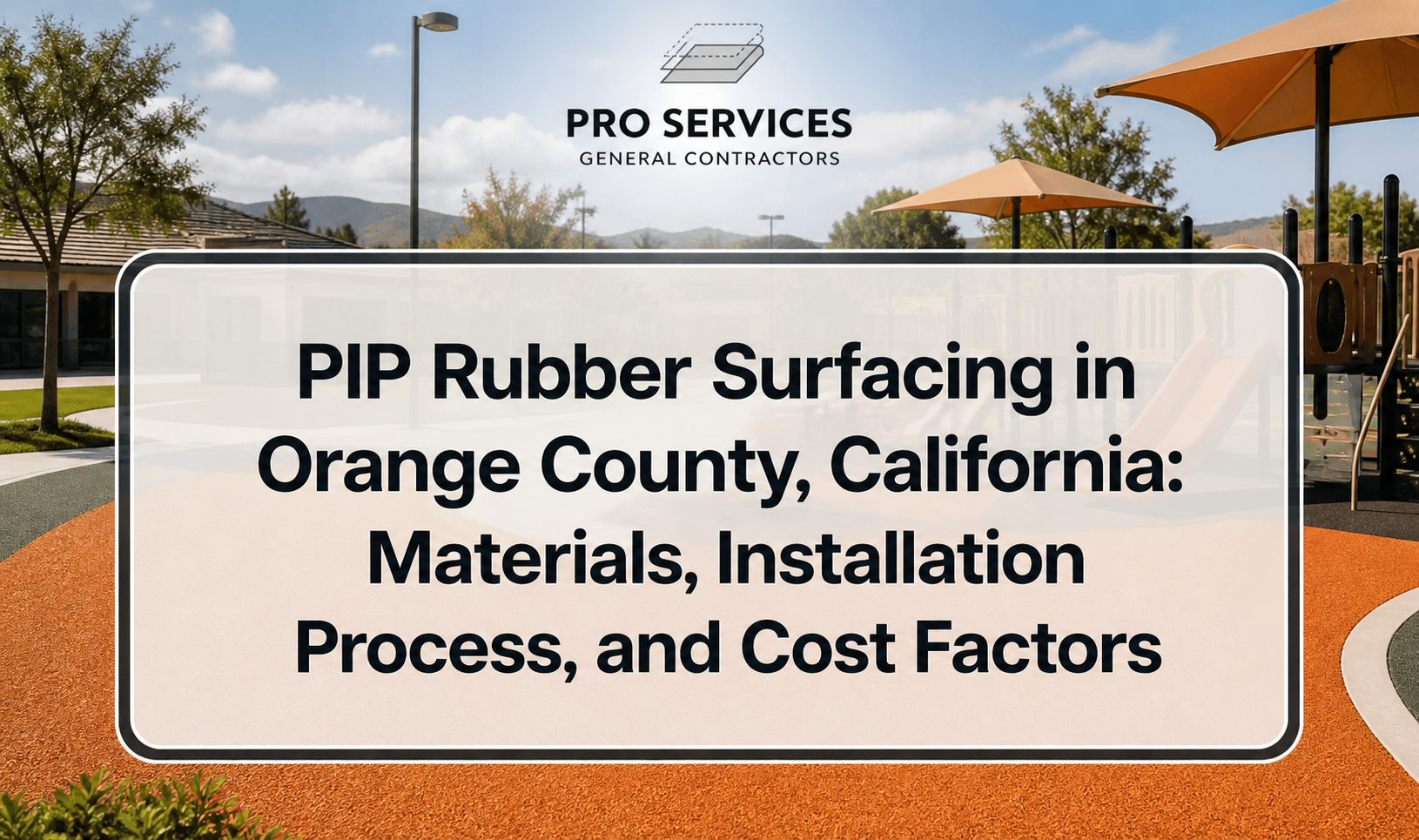
PIP rubber surfacing Orange County projects typically use a two-layer, poured-in-place system—an impact-attenuating base made from recycled rubber granules and a durable EPDM wear layer—installed to create a seamless, slip-resistant play surface.
In Orange County, this surfacing is commonly specified for playgrounds, parks, and school campuses because it supports ADA accessibility when properly designed, helps manage fall-risk through depth selection, and holds up to heavy foot traffic, sun exposure, and irrigation overspray common to outdoor recreation areas. Material choices, site drainage, and concrete or asphalt subbase condition all affect long-term performance.
This guide breaks down the key materials used, the step-by-step installation process (from base prep and mixing to troweling and curing), and the main cost drivers such as square footage, thickness, color patterns, repairs, and subbase work.
What “PIP” Rubber Surfacing Means for Orange County Sites
PIP rubber surfacing Orange County projects typically refer to a seamless, troweled rubber system installed in place (rather than rolled out), designed to reduce trip hazards and improve accessibility around play equipment.
Most poured-in-place rubber systems are built as a two-layer assembly: a cushioned base layer made from recycled rubber bound with polyurethane, and a colored EPDM wear layer for UV stability and day-to-day durability. This combination is popular for public-facing spaces because it can be formed around curves, ramps, and playground edges without seams that split or curl over time.
In Orange County, planning the system around local site realities matters just as much as choosing colors. Sun exposure, irrigation overspray, coastal moisture in some areas, and heavy weekend foot traffic all influence which binder, wear-layer thickness, and drainage approach will perform best long-term.
Where Poured-In-Place Rubber Is Commonly Specified
PIP is frequently selected when owners need a durable, accessible surface that can handle high use with minimal day-to-day disruption.
Because it’s installed continuously, poured rubber is often easier to integrate with accessible routes than loose-fill options. It also supports creative graphics (games, mascots, wayfinding bands) that many schools and parks use to define play zones.
- Public parks and tot lots where weekend crowding increases wear at entry points and under swings/slides
- School campuses that need consistent accessibility across multiple play areas and walkways
- HOA and apartment amenities that prioritize a clean, finished look with fewer loose materials to track
- Inclusive playgrounds that benefit from smooth rolling conditions for mobility devices when properly designed
- Water-adjacent areas (when detailed correctly) that need slip resistance and good drainage behavior
If your project includes multiple surface types (for example, turf for open lawn plus rubber at equipment fall zones), budgeting and transitions should be planned early so edges, elevations, and drainage lines up cleanly.
Key Materials in a Two-Layer PIP System
PIP systems succeed or fail based on material compatibility, mix ratios, and how well the final assembly matches the site’s drainage and use patterns.
Base Layer: Recycled SBR + Polyurethane Binder
The base course is typically made from recycled SBR rubber granules mixed with a polyurethane binder, providing the bulk of impact attenuation.
This layer is where thickness is adjusted to help manage fall-risk under equipment. The base must be mixed thoroughly and placed consistently; thin spots, dry pockets, or binder-rich areas can cause weak zones that crack or ravel later.
- What it does: absorbs impact and builds the required depth
- What affects performance: binder quality, mixing time, ambient conditions, and installation workmanship
- Common failure modes: delamination from poor priming, soft spots from incorrect ratios, cracking from subbase movement
Wear Layer: EPDM Granules for Color and UV Resistance
The top layer is usually EPDM rubber granules mixed with binder to create a dense, resilient wearing surface.
EPDM is chosen because it holds color better in sun exposure than many alternatives and creates a finished texture that’s comfortable underfoot. Color blends, mottling, and multi-color patterns are possible, but the more intricate the design, the more important layout control and clean trowel work become.
- Typical design options: single color field, borders, speckles, logos, hopscotch/4-square games
- Practical note: darker colors may show dust and fade differently than lighter blends over time
Edges, Transitions, and Restraints
Perimeters and transitions control cracking, curling, and water intrusion, especially where rubber meets concrete, curbs, or unit pavers.
Well-executed projects often include a clear plan for edge restraint, terminations, and height matching to adjacent hardscape. Transitions are also where accessibility can be compromised if heights are mismatched or slopes are inconsistent.
- Common transitions: rubber-to-concrete walkways, rubber-to-turf edges, rubber-to-curb terminations
- Why it matters: weak edges are frequent starting points for peeling and delamination
Subbase and Drainage: The Make-or-Break Factor
PIP rubber surfacing Orange County installations last longer when the subbase is sound, properly sloped, and able to move water away from the system.
Poured rubber is not a waterproofing system. If water sits under or within the surface due to poor slope, clogged drains, or depressed subbase areas, you can see premature wear, freeze-thaw damage in rare cold snaps, or localized debonding. Even in mild Southern California weather, trapped moisture can still stress the bond line and concentrate deterioration at low points.
| Project Element | What to Verify / Specify | Orange County Site Considerations |
|---|---|---|
| Subbase type | Concrete or asphalt in good condition, clean, and properly sloped | Older park slabs may have cracks or settlement that telegraph through without repairs |
| Surface drainage | Positive slope to drain inlets or perimeter collection | Irrigation overspray can create persistent wet zones if slopes are marginal |
| Crack and spall repairs | Patch, grind, and stabilize moving cracks before surfacing | Tree roots and soil movement can re-open untreated cracks at edges |
| Transitions and thresholds | Flush transitions; avoid abrupt lips that catch wheels or toes | Common at playground gates, ramps, and equipment borders where elevations change |
| Equipment fall zones | Thickness selection coordinated to equipment layout and fall height needs | Plan thicker sections early to prevent elevation conflicts with adjacent concrete paths |
For background on common playground surface types and how they’re generally categorized, you can reference playground surfacing.
Step-by-Step Installation Workflow (What Owners Should Expect)
A quality installation follows a predictable sequence: prepare the subbase, install the base course, apply the wear course, then protect the area during curing.
Exact procedures vary by manufacturer and installer, but most issues stem from skipping steps under schedule pressure—especially cleaning/priming, consistent mixing, and protecting the surface from early use.
1) Site Assessment and Layout
Before mixing any material, crews verify slopes, mark elevations, and confirm equipment locations and edge restraints.
- Confirm subbase type and condition (asphalt vs. concrete, cracks, low spots)
- Check drainage: where water currently flows and where it ponds
- Finalize layout: fall zones, transitions, graphics, and any ADA routes
- Coordinate with other trades: playground equipment, concrete flatwork, shade elements
2) Subbase Cleaning, Repairs, and Priming
The rubber system relies on strong adhesion; dust, oils, curing compounds, and loose patches can compromise bond strength.
Repairs should be completed and cured before surfacing begins. Primers (when specified) are used to improve adhesion and reduce the risk of delamination—especially on porous or weathered asphalt.
- Remove debris and contaminants (sweeping, blowing, pressure washing when appropriate)
- Patch spalls and failures; address deteriorated asphalt areas
- Stabilize or treat cracks based on whether they are moving or non-moving
- Apply primer per manufacturer guidance and ambient conditions
3) Mixing and Installing the Base Course
The base layer is mixed in controlled batches and placed to a consistent thickness, then troweled to a uniform plane.
Installers typically work in sections to maintain a wet edge and avoid cold joints. Thickness control is critical: the surface may look fine on day one but fail impact performance requirements if the base is too thin in key areas.
- Measure and stage materials for consistent batch sizing
- Mix SBR and binder until evenly coated (no dry pockets)
- Place material and screed/trowel to target thickness
- Detail edges tightly at curbs, ramps, and equipment borders
4) Installing the EPDM Wear Layer
The wear layer is applied after the base is ready, creating the finished color, texture, and long-term durability.
Graphics and patterns are usually installed using templates, forms, or taped layout lines. More colors and shapes increase labor, and small detailing errors are difficult to hide once cured.
- Mix EPDM granules with binder uniformly
- Trowel to consistent thickness and texture
- Install patterns/graphics carefully to avoid color bleed or uneven edges
- Maintain clean transitions at borders and ramps
5) Curing, Protection, and Reopening
Curing time depends on product chemistry and ambient conditions, and early foot traffic can permanently mar the surface.
Owners should plan for temporary closures and protect the work from irrigation overspray during curing. Reopening should happen only after the installer confirms the surface is sufficiently cured and ready for use.
- Restrict access (fencing and signage)
- Avoid irrigation hitting uncured rubber (can discolor and interfere with cure)
- Coordinate reopening with school or park schedules to prevent premature damage
Design and Performance Considerations (Beyond Color)
The best results come from designing for use patterns, maintenance realities, and accessibility—not just selecting an attractive color palette.
Seamless surfacing still needs intentional detailing to reduce concentrated wear at entries, under swings, and at slide exits. It also benefits from planning cleaning access, shade placement, and drainage routes so the surface stays drier and safer.
Fall Zones and Thickness Planning
Thickness selection should be coordinated with equipment fall heights and the owner’s safety goals.
Because thickness changes can create elevation conflicts at borders, it’s smart to map out thickened areas early. When in doubt, ask for thickness callouts on plans so installers aren’t forced to guess in the field.
- Identify highest-risk zones (swings, climbers, spinners)
- Plan thickened pads without creating trip edges at transitions
- Confirm the surface design matches the final equipment set (not a preliminary layout)
Slip Resistance, Heat, and Comfort
EPDM wear layers provide traction, but surface temperature and comfort can vary by color, shading, and exposure.
Darker colors can feel hotter in direct sun, while shaded areas often stay more comfortable and may reduce UV-driven aging. Where heat is a concern, consider shade planning and lighter color blends rather than assuming a single fix.
- Use color strategically in full-sun zones
- Consider shade structures to improve comfort and reduce UV exposure on high-use areas
- Account for irrigation and drainage so the surface doesn’t stay wet and slippery in low spots
Main Cost Drivers for PIP Rubber Surfacing in Orange County
Project cost is usually shaped by size, thickness requirements, design complexity, and the condition of the existing subbase.
Because many variables are site-specific, estimates can swing significantly between two projects with similar square footage. For budgeting, it helps to separate the “rubber system” cost from subbase repair work, demolition, and any schedule constraints that require phased work.
- Total square footage: larger areas can reduce per-square-foot overhead, but logistics still matter
- Thickness requirements: more depth typically means more material and labor
- Color and graphics: multi-color patterns, logos, and game layouts add layout time and detailing
- Subbase condition: crack repairs, patching, grinding, or rework can be a major variable
- Access and staging: tight gates, limited parking, or restricted work hours can increase labor
- Phasing and schedule: school calendars or park closures can force segmented installs with additional mobilizations
If you’re comparing surface options for long-term value (not just initial price), it’s useful to weigh lifecycle issues like repairs, downtime, and how well the surface tolerates high-traffic pinch points. The principles discussed in why cheap surfacing costs more long-term are relevant when evaluating rubber vs. other surface types or lower-cost install shortcuts.
Maintenance and Repair Planning (What Owners Can Control)
Routine cleaning and quick repairs help preserve appearance, traction, and edge integrity—especially in high-use zones.
Poured rubber is durable, but it isn’t maintenance-free. Most sites benefit from a simple plan that addresses debris removal, stain management, and early intervention when small cracks or edge lifting appear.
- Regular cleaning: remove sand, leaves, and debris that can abrade the wear layer
- Stain awareness: fertilizer, rust, food spills, and irrigation minerals may discolor over time
- Edge inspections: check perimeters near curbs, ramps, and gates where peeling often begins
- Prompt repairs: patch small damaged spots before water intrusion enlarges the failure
For a deeper look at what ongoing care typically involves, review PIP maintenance to understand common upkeep tasks and how they relate to long-term performance.
Choosing the Right System and Installer for Orange County Conditions
The right PIP system is the one that matches your site’s subbase, drainage, use intensity, and design goals—installed by a crew that controls mix consistency and finishing quality.
When reviewing proposals, prioritize scope clarity over vague promises. You want to see how the contractor plans to handle subbase prep, transitions, drainage details, and protection during curing—because those items often determine whether the surface looks great for years or starts failing at the edges and low spots.
- Ask how subbase cracks, low spots, and drainage problems will be addressed before surfacing
- Confirm thickness planning for fall zones is reflected in drawings or written scope
- Request clarity on color layout, pattern boundaries, and how seams/joints will be handled
- Discuss site restrictions: school hours, park access, noise limits, and staging space
If you’re still narrowing down which surface type best fits your program, exploring poured in place rubber details alongside other accessible surfacing options can help you set realistic expectations for performance, appearance, and upkeep.
Planning a Smoother Project Start (Before You Break Ground)
A few preconstruction checks—especially around drainage, elevations, and scheduling—can prevent the most common delays and rework on PIP rubber surfacing Orange County installations.
Owners and project managers can reduce risk by aligning the rubber scope with the final playground layout, confirming subbase readiness, and coordinating irrigation and access control during cure. These steps are straightforward, but they’re often missed when teams focus only on color selection and square footage.
- Verify subbase condition: inspect for ponding, cracks, spalls, and settlement at edges.
- Confirm final equipment set: ensure fall zones and thickened areas match the installed equipment, not a preliminary plan.
- Coordinate elevations: check transitions at gates, ramps, curbs, and adjacent flatwork.
- Plan water management: adjust irrigation to minimize overspray during curing and reduce chronic wet areas.
- Set protection rules: define closure boundaries and reopening procedures to prevent early damage.
With these items addressed upfront, poured rubber is more likely to deliver what most Orange County stakeholders want: a clean, continuous, accessible surface that holds up under daily use with predictable maintenance.
Frequently Asked Questions
Get a Poured-in-Place Rubber Plan That Fits Your Site Conditions
If you’re planning a poured-in-place rubber surface for a park, school, HOA, or community play area in Orange County, the next step is confirming what will actually perform on your subbase and drainage—before colors and patterns lock in the scope. A quick review of slopes, edges, and wear hot spots can prevent change orders and help you plan realistic closures and cure protection.
Orange County Poured in Place Rubber Pros LLC can help you clarify thickness needs, transitions, and prep requirements so the finished surface stays seamless, accessible, and easier to maintain over time.