
The Benefits of Poured in Place Rubber for Playgrounds in Orange County, California
Executive Summary
Poured-in-place rubber playground surfacing in Orange County typically follows a predictable sequence—planning, site prep, base work, rubber installation, and curing—with the base condition and cure time driving most schedule variability. With proper phasing and realistic buffers, schools, parks, and HOAs can minimize downtime while improving safety, accessibility, and long-term maintenance efficiency.
Key Takeaways
- Timelines Are Predictable When Phased Correctly: Most projects move from approvals to prep, base work, rubber layers, and a 24–72 hour cure window before reopening.
- Base Condition Is the #1 Schedule Variable: Cracks, drainage failures, or unstable subgrade discovered during demolition can add days and should be evaluated early.
- On-Site Installation Is Often Faster Than Expected: Many small sites finish in ~2–5 working days, medium school sites in ~5–10 days, while larger parks may take 2–4+ weeks when phased.
- Design and Fall-Height Specs Affect Both Time and Cost: Greater thickness requirements and multi-color graphics increase labor, material handling, and detailing time.
- Maintenance Planning Reduces Future Closures: Routine cleaning and targeted spot repairs help extend surface life and avoid frequent, disruptive resurfacing cycles.
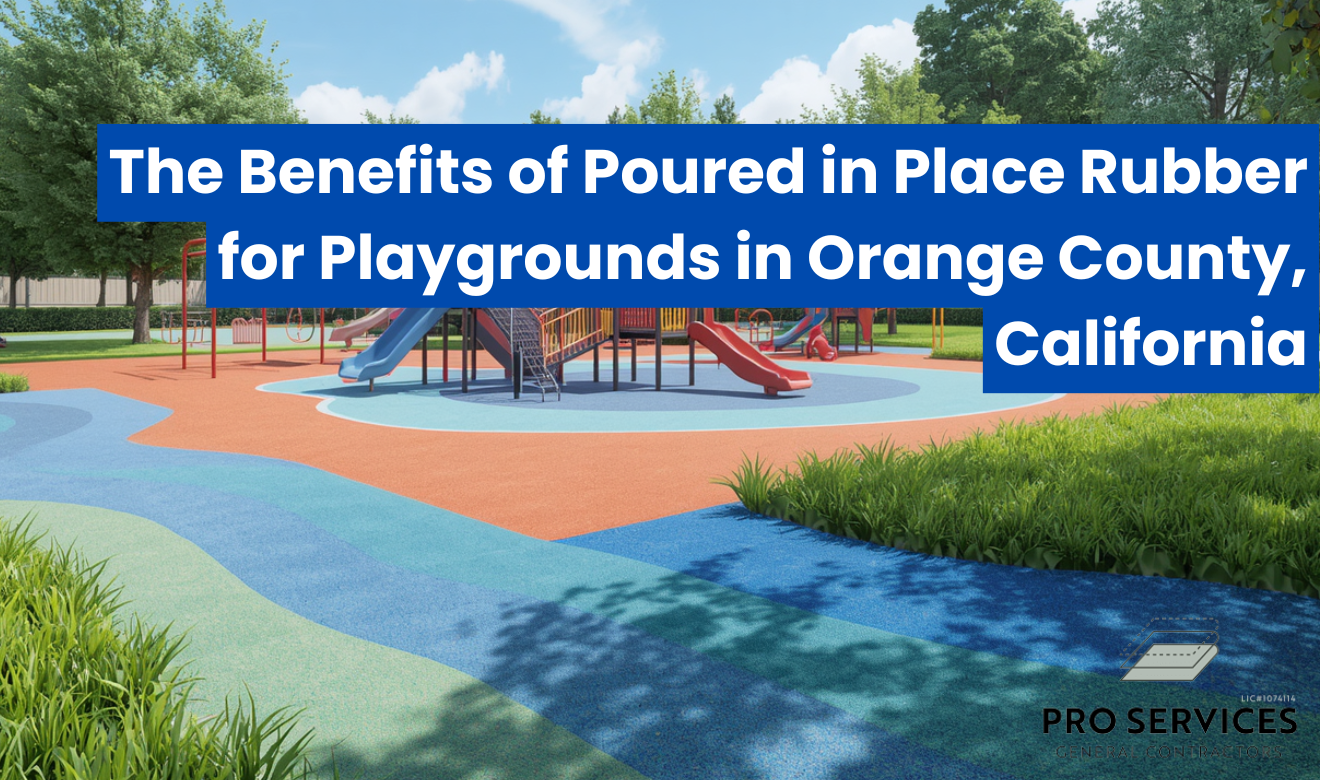
Poured-in-place rubber is a smart choice for playgrounds in Orange County, California because it delivers reliable fall protection, easy accessibility, and a clean, modern look that holds up to heavy daily use. It creates a seamless surface that helps reduce trips and puddles, so kids can move from swings to slides without hitting loose mulch or scattered gravel.
If you’re planning around a poured in place rubber timeline Orange County projects often follow predictable steps: site prep, base installation, rubber layers, and curing before kids can play again. For example, a school can schedule installation during a break to minimize downtime, while a park can phase the work by section to keep part of the play area open.
It also makes maintenance simpler in real life. Spills, sand, and leaves can be blown or rinsed off, and high-traffic zones under slides or monkey bars can be repaired without replacing the entire surface. For families and facility teams, that means a playground that stays safer, cleaner, and easier to use year after year.
What a Poured in Place Rubber Timeline Orange County Projects Typically Looks Like
A realistic poured in place rubber timeline Orange County projects follow is usually measured in weeks (planning and procurement) and days (on-site installation). The exact schedule depends on square footage, site access, weather, and whether you’re building new or resurfacing over an existing area.
Most sites move through these predictable phases:
- Planning & approvals (1–6+ weeks): scope, colors/layout, submittals, and any district/city approvals.
- Site prep & demolition (1–3 days): remove old surfacing and correct drainage/slope issues.
- Base installation or repairs (1–3 days): asphalt or concrete base (or repairs if it already exists).
- Rubber installation (1–3 days): pour the resilient base layer, then the colored wear layer.
- Cure time (24–72 hours): restrict use until fully cured (varies by system and conditions).
If you’re comparing surfaces or working through safety and accessibility questions, it helps to understand the basics of playground surfacing and how different systems perform in real outdoor environments.
How the Installation Process Works (Step-by-Step)
Understanding the steps is the fastest way to predict your poured in place rubber timeline Orange County teams can commit to. While methods vary by contractor and specification, the workflow generally follows industry-standard practice: stable base first, then rubber layers, then cure.
Step 1: Site Walk, Measuring, and Layout
Before materials are ordered, teams confirm:
- Play equipment locations and fall zones
- Drainage pathways and low spots that may puddle
- Edges, transitions, ADA routes, gates, and access points
- Proposed thickness based on equipment fall height requirements
Step 2: Demolition and Subgrade Prep (if needed)
For resurfacing jobs, demolition can be the schedule wildcard. A poured in place rubber timeline Orange County retrofit may slow down if crews uncover:
- Base failure (cracking, heaving, delamination)
- Root intrusion
- Drainage problems that require regrading
- Hidden irrigation or electrical conflicts
Step 3: Base Install or Base Repair
Poured-in-place rubber requires a stable base (commonly asphalt or concrete). A clean, properly sloped base is a major driver of longevity and fewer repairs later.
- New base: adds time and cost, but reduces risk.
- Existing base: faster, but only if it’s structurally sound and drains correctly.
Step 4: Rubber Base Layer (Cushion Layer)
This is the shock-absorbing layer. Thickness is selected to meet the project’s safety performance goals for falls (often written into bid specs and tied to the equipment fall height). This part strongly influences both safety and budget.
Step 5: Wear Layer (Topcoat Layer)
The wear layer is the colored, tighter-textured top that you see and walk on. It affects:
- Slip resistance and daily comfort
- Color design options (graphics, games, patterns)
- Cleanability and appearance over time
Step 6: Cure Time and Reopening
Even when installation is fast, cure time is non-negotiable. Most poured in place rubber timeline Orange County schedules build in at least 24–72 hours before reopening, depending on temperature, humidity, and product specification.
How Long Does Poured-In-Place Rubber Take in Orange County?
On-site work is often quicker than people expect. For many playground footprints, the poured in place rubber timeline Orange County crews plan for is commonly:
- Small sites (daycare courtyards, small tot lots): ~2–5 working days on-site including prep, install, and cure buffer.
- Medium sites (school playgrounds): ~5–10 working days including base work and cure buffer.
- Large sites (parks with multiple zones): ~2–4+ weeks if phased, especially when keeping partial access open.
Phasing is common for parks and shared-use facilities because it maintains access and helps distribute disruption.
What Impacts the Poured in Place Rubber Timeline Orange County Teams Can Promise?
Two projects with the same square footage can have different schedules. The biggest drivers of a poured in place rubber timeline Orange County plan are usually the base condition and logistics.
Base condition (the #1 schedule variable)
- If the base is cracked or has drainage failure, repairs can add days.
- If demolition reveals unstable subgrade, excavation and recompaction may be required.
Thickness requirements based on fall height
More thickness typically means:
- More material to mix and place
- More labor time
- More cure sensitivity in extreme heat
Weather and temperature swings
Orange County weather is often installation-friendly, but even mild coastal conditions can affect cure. Morning marine layer, humidity, and heat waves can all influence timing in a poured in place rubber timeline Orange County schedule.
Access restrictions and operating hours
- Schools may restrict access to evenings/weekends or break windows.
- Parks may require pedestrian routing, fencing, and public safety staging.
- Urban locations may have limited staging space for materials and mixers.
Design complexity (graphics, multiple colors, game layouts)
Custom designs are popular because they add play value, but each additional color transition and graphic can add layout time and detailing. That’s not “bad”—it just needs to be reflected in the poured in place rubber timeline Orange County plan.
Cost: What to Expect When Planning Schedule and Budget Together
Costs vary widely based on thickness, base work, and design. Instead of quoting numbers that may not match your site, it’s more useful to understand the biggest cost-and-timeline connections:
- Base repairs often add both time and budget—but skipping them can shorten lifespan.
- Higher fall-height areas generally require thicker rubber, increasing labor and materials.
- Custom graphics add labor time and can extend the poured in place rubber timeline Orange County install window.
- Phased construction can increase mobilization time but keeps facilities partially open.
If you’re weighing “cheaper now” options against long-term performance, this breakdown is helpful: why cheap surfacing costs more long-term.
Why Fall Protection and Accessibility Requirements Affect the Timeline
Safety and access aren’t “extras”—they shape the specification and therefore the poured in place rubber timeline Orange County projects must follow.
Fall protection performance (ASTM context)
Playground owners commonly require testing and performance alignment with widely used ASTM standards (like impact attenuation and accessibility guidance used across the U.S.). That often translates into:
- Defined thickness by equipment fall height
- Attention to transitions (ramps, curbs, edges)
- Quality control for seams, joins, and drainage
ADA access considerations
One reason poured-in-place rubber is popular is that it supports mobility devices with fewer issues than loose-fill surfaces. Still, meeting accessibility goals requires:
- Proper slopes and cross slopes
- Clean transitions at borders
- Consistent, stable surfacing across routes
Getting these details right may add some install time, but it typically reduces long-term complaints and patchwork fixes—an important tradeoff in any poured in place rubber timeline Orange County plan.
How to Plan a Poured in Place Rubber Timeline Orange County Schools and Parks Can Actually Use
Scheduling is where projects succeed or stall. Here are planning approaches that work well locally.
For schools (minimal downtime)
- Target breaks: summer, winter break, spring break (depending on scope).
- Front-load base work: if asphalt/concrete needs cure time, do it early in the break window.
- Stage materials: ensure deliveries don’t conflict with campus traffic hours.
- Lock equipment early: finalize equipment layout so thickness zones are known before install.
When schools want a predictable path from submittals to reopening day, it helps to reference a documented PIP process so stakeholders understand each phase and why cure time matters.
For parks (phased construction)
- Phase by zone: swings first, then slides/climbers, then pathways and borders.
- Maintain a safe route: fence off active work with clear pedestrian detours.
- Schedule around events: avoid major community weekends when possible.
For HOAs and apartment communities
- Communicate closures early: residents tolerate short closures better with clear dates.
- Prioritize entries and paths: ensure accessible routes reopen first.
- Plan for noise windows: mixing and prep can be louder than the pour itself.
What Maintenance Looks Like After Installation (and How It Affects Long-Term Scheduling)
Maintenance planning is part of the poured in place rubber timeline Orange County conversation because it affects how often you’ll need closures later.
Routine maintenance (weekly/monthly)
- Blow off leaves and sand to reduce abrasion
- Rinse spills and sticky residue before it attracts dirt
- Inspect high-wear zones under swings and slide exits
Periodic maintenance (seasonal/annual)
- Deep cleaning as needed (especially shaded, damp corners)
- Edge checks at borders and transitions
- Spot repairs for cuts, vandalism, or localized wear
A key advantage is that many issues can be repaired in a small area, which can keep closures short compared to replacing an entire playground. For a practical checklist and closure planning, see PIP maintenance.
Table: Typical Milestones in a Poured in Place Rubber Timeline Orange County Stakeholders Can Track
| Milestone | What happens | Common time range |
|---|---|---|
| Preconstruction review | Measure site, confirm layout, verify access and drainage plan | 1 day to 1 week (depends on approvals) |
| Demo & prep | Remove old surfacing, correct grades, prep edges | 1–3 days |
| Base install/repair | New asphalt/concrete or repairs; ensure slope and stability | 1–3+ days |
| Rubber install & cure | Pour base layer, pour wear layer, allow cure before reopening | 2–6 days (including cure buffer) |
Why Poured-in-Place Rubber Works So Well for Orange County Use Cases
For many facilities, the decision comes down to performance under heavy use. Poured-in-place rubber is often chosen because it provides a continuous, accessible surface without the displacement and daily raking associated with loose-fill options.
In real operations terms, it can help reduce:
- Trip points caused by scattered mulch or uneven ruts
- Mess tracked into classrooms, offices, or vehicles
- Frequent “top-off” labor and material deliveries
Those operational realities are a big reason the poured in place rubber timeline Orange County planning effort is worth it: you take a short closure up front to avoid repeated micro-closures and ongoing cleanup later.
Common Scheduling Mistakes to Avoid
If you want a smoother poured in place rubber timeline Orange County project, these are the pitfalls that most often cause delays:
- Underestimating base repairs: the surface is only as good as what it’s bonded to.
- Not planning cure time: reopening too early can damage the wear layer.
- Ignoring drainage: standing water shortens life and increases slip/algae risk.
- Overcomplicating graphics late: design changes late in the process can disrupt material ordering and layout.
- No plan for access control: lack of fencing/signage can create safety hazards and liability.
Built to Last: The Smart Way to Reopen Faster and Keep It Safer
The most reliable poured in place rubber timeline Orange County outcomes come from getting three things right: a stable draining base, correct thickness for fall zones, and realistic cure-time planning. When those are aligned, schools can time installs to breaks, parks can phase sections without shutting everything down, and facility teams can maintain the surface with simple cleaning plus targeted repairs.
From an industry perspective, best practice is to align playground surfacing decisions with widely used safety and accessibility frameworks (including ASTM guidance commonly referenced in public bids), and to rely on crews experienced in base evaluation, drainage correction, and layered rubber installation sequencing. That combination is what consistently turns a poured in place rubber timeline Orange County plan into a predictable reopening date—without sacrificing long-term performance.
Frequently Asked Questions
Want a Timeline You Can Actually Count On in Orange County?
If you’re planning a playground upgrade and need a realistic poured-in-place rubber schedule (with fewer surprises and a clear reopen date), get a local team to walk the site, evaluate the base, and map out the phases before you commit. Orange County Poured in Place Rubber Pros LLC can help you dial in thickness by fall height, identify drainage or base issues early, and build a timeline that fits school breaks, park phasing, or HOA access—so you don’t lose weeks to avoidable delays.
Related Posts

The Ultimate Guide to Rubber Playground Flooring in San Diego, California
Executive Summary Rubber playground flooring San Diego performs best when it is specified and installed…

Top Quality Rubber Playground Flooring Options in Orange County, California
Executive Summary Rubber playground flooring in Orange County performs best when specified and built as…
Leave a Reply