
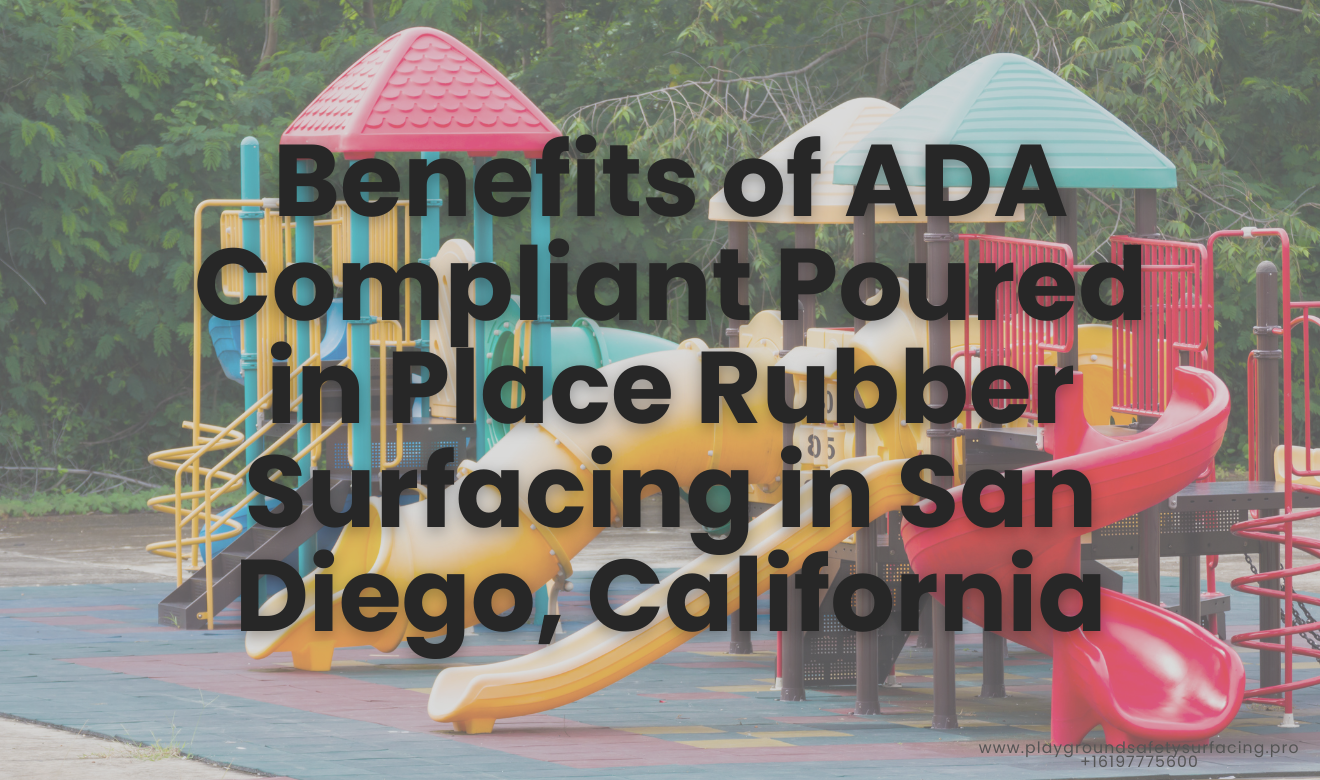
Benefits of ADA Compliant Poured in Place Rubber Surfacing in San Diego, California
Executive Summary
ADA poured-in-place (PIP) rubber surfacing is often chosen in San Diego because it delivers a continuous, firm, stable, slip-resistant surface that supports long-term accessibility and safer circulation in parks, schools, and public spaces. Its real performance depends heavily on correct base preparation, drainage, and transition detailing—not just the rubber material itself.
Key Takeaways
- Continuous, unitary surface improves accessibility: PIP rubber reduces seams, shifting, and loose-fill movement that commonly create rolling resistance and trip hazards.
- Solves “accessible on day one, not after a year” issues: It helps prevent ruts, displaced surfacing, and uneven transitions that often trigger ADA usability complaints over time.
- ADA success is performance-based, not product-name-based: Compliance hinges on achieving firm/stable/slip-resistant conditions, correct slopes, smooth level changes, and adequate clear widths/turning space.
- Base, drainage, and edge detailing drive durability: Many failures attributed to rubber are actually caused by poor substrate integrity, ponding, or poorly executed transitions at curbs, drains, ramps, and borders.
- San Diego climate fit is strong with the right spec and upkeep: UV, salt air, and occasional heavy rain are manageable when wear layers, color/heat considerations, cleanup routines, and preventive maintenance are planned.
ADA compliant poured-in-place rubber surfacing is a smart choice in San Diego because it creates a smooth, stable, slip-resistant path that helps people using wheelchairs, walkers, and strollers move safely and comfortably. With ADA poured in place rubber San Diego installations, you can avoid common accessibility issues like loose mulch, shifting gravel, and uneven concrete joints that can cause trips or make rolling difficult. For example, a beachfront park can use it to keep routes firm even after wind and sand build-up nearby, and a school playground can use it to reduce fall injuries while still meeting accessibility needs. It also handles San Diego’s sun and occasional heavy rain well, staying resilient without turning into muddy or rutted surfaces.
What makes ADA poured-in-place rubber surfacing different from other “accessible” surfaces?
Many surfaces are marketed as “wheelchair-friendly,” but ADA poured in place rubber San Diego projects are typically selected because the surface can be built as a continuous, unitary layer—reducing the seams, shifting, and loose fill that often cause accessibility complaints.
Compared with alternatives like engineered wood fiber, decomposed granite, or loose rubber mulch, ADA poured in place rubber San Diego surfacing is designed to stay:
- Firm and stable for rolling mobility devices and strollers
- Slip-resistant when properly installed and maintained
- Seam-minimized (helpful where sidewalk joints or transitions are a trip risk)
- Impact-attenuating for play areas when built to the required thickness
It’s also a common choice where the goal is to combine safety + usability without creating a “separate route” for people with disabilities—an important practical outcome of good accessibility planning.
How does ADA poured in place rubber San Diego help with real-world accessibility?
ADA poured in place rubber San Diego installations address the everyday issues that trigger the most complaints: rolling resistance, unstable footing, and abrupt changes in level.
Accessibility problems it helps prevent
- Loose-fill displacement: Wood fiber and mulch migrate after use, wind, or maintenance.
- Ruts and low spots: Common in high-traffic paths and play entry points.
- Trip edges: Pavers and older concrete can separate or settle.
- Hard-to-navigate transitions: Especially at playground borders, ramps, and gate entries.
Two common San Diego scenarios (and why they matter)
- Coastal parks: Windblown sand and salt air add maintenance challenges. A continuous surface helps keep routes usable even when nearby sand builds up (you still need routine sweeping, but the route itself stays intact).
- Schools and inclusive playgrounds: When properly designed for fall protection, the surface can reduce injury severity while supporting mobility devices on the same play route.
In short: ADA poured in place rubber San Diego surfacing is often chosen because it solves the “it was accessible on day one, but not after a year” problem.
What ADA requirements matter most for poured-in-place rubber?
For owners and specifiers, the big focus is not the material name—it’s whether the built surface meets accessibility performance expectations.
Key ADA-related considerations to verify
- Stable, firm, slip-resistant surface: This is a core expectation for accessible routes (especially when wet).
- Cross slope and running slope: Design and substrate prep matter as much as the rubber layer.
- Changes in level at transitions: Entries from sidewalks, ramps, and play borders must be detailed correctly.
- Clear widths and turning space: Routes through and around the play area need room to maneuver.
For playgrounds specifically, the ADA Standards include technical requirements for accessible routes within play areas and access to play components. The surface must support that route without creating excessive resistance or instability.
If you’re comparing systems, it helps to understand the broader categories of playground surfacing and how each behaves over time—not just how it looks on installation day.
How is ADA poured in place rubber San Diego installed (and why the base matters)?
Most performance failures blamed on the “rubber” are actually base, drainage, or detailing issues. ADA poured in place rubber San Diego work is highly dependent on correct substrate preparation.
Typical build-up (high level)
- Substrate evaluation: Inspect existing asphalt/concrete or prepare a new aggregate base.
- Drainage planning: Ensure water has a path out—especially near turf edges, curbs, and low points.
- Two-layer system: A resilient base layer + a wear/top layer (often colored) for durability and UV stability.
- Seam and edge detailing: Transitions to sidewalks, curbs, ramps, and equipment footings are finished to avoid lips and gaps.
- Cure time + final walk-through: Confirm slopes, transitions, and surface continuity.
If you want to dive deeper into build sequencing and what to look for during construction, see Poured In Place Rubber for an overview of system basics and common applications.
Cost: what affects pricing for ADA poured in place rubber San Diego?
Pricing varies widely because it’s tied to safety performance, access details, and site conditions—not just square footage. ADA poured in place rubber San Diego budgets typically change based on these factors:
- Area size and geometry: Curves, inlays, and tight corners increase labor time.
- Required impact attenuation (play areas): Higher fall heights generally require thicker systems.
- Base condition: Repairing or replacing asphalt/concrete can be a major cost driver.
- Drainage and grading corrections: Fixing slope issues prevents ponding and premature wear.
- Access constraints: Rooftops, limited staging areas, and restricted work hours can affect production rates.
- Design features: Color blends, graphics, striping, and custom patterns add complexity.
A practical way to control long-term cost is to focus on lifecycle value—materials, base prep, and maintenance planning. If you’re weighing budget options, this breakdown of why low bids can become expensive later is useful: why cheap surfacing costs more long term.
Why ADA poured in place rubber San Diego performs well in sun, salt air, and rain
San Diego brings a unique mix: intense UV exposure, coastal salt air in many neighborhoods, and occasional heavy rain events that test drainage. ADA poured in place rubber San Diego surfacing can do well here when the system is specified and maintained appropriately.
Performance advantages in this climate
- UV resilience: Quality wear layers are designed to resist fading and degradation better than many loose-fill options.
- No “mud season”: Unlike soil-based paths, the surface does not turn to ruts during storms.
- Predictable traction: A consistent surface helps users transition between dry and wet conditions.
What still needs attention
- Drainage detailing: Ponding shortens life and can create slip risks.
- Heat management: Dark colors can get hot in direct sun; shade and color selection matter.
- Salt + sand cleanup: Coastal sites often require more frequent sweeping or rinsing.
In other words, ADA poured in place rubber San Diego projects aren’t “install and forget”—but they are easier to keep consistently accessible than many alternatives.
What to choose: poured-in-place rubber vs. porous rubber surfaces
People often compare ADA poured in place rubber San Diego systems with porous rubber pavement because both can be slip-resistant and accessible when properly designed. The best choice depends on use, drainage needs, and whether the area is a playground safety zone or a pedestrian route.
| Feature | Poured-in-place rubber (PIP) | Porous rubber surface |
|---|---|---|
| Best for | Playgrounds, inclusive play routes, plazas, campus courtyards | Pedestrian paths, trails, some multi-purpose areas |
| Drainage approach | Typically managed by slope + drains (varies by system) | Designed to let water pass through (system dependent) |
| Design flexibility | High (colors, graphics, inclusive play cues) | Moderate (often more uniform aesthetics) |
| Common spec driver | Fall protection + accessibility in one surface | Stormwater + comfortable walking/rolling surface |
Both can support accessibility goals, but if your project revolves around playground safety + inclusive circulation, ADA poured in place rubber San Diego systems are often the first place planners start.
How to maintain ADA poured in place rubber San Diego for long-term compliance
Accessibility is not just an installation checklist—it’s ongoing performance. A maintenance plan helps ADA poured in place rubber San Diego surfacing remain stable, slip-resistant, and free of trip edges.
Simple maintenance tasks that make a big difference
- Sweep debris regularly: Leaves, sand, and bark dust can reduce traction.
- Rinse as needed: Especially after coastal winds or high-use weekends.
- Inspect edges and transitions: Look for curling, separation, or movement at curbs and drains.
- Address small damage early: Minor cuts or delamination can grow if water gets underneath.
- Plan periodic deep cleaning: Helps preserve appearance and surface grip.
Also consider operational realities: parks and schools often need maintenance that can be done quickly between heavy-use periods. That’s another reason ADA poured in place rubber San Diego surfaces are popular—they’re maintainable without constantly re-grading or topping off loose material.
Where ADA poured in place rubber San Diego is used most (and why)
Because it combines accessibility and safety, ADA poured in place rubber San Diego installations are common across public, commercial, and residential community settings.
High-fit applications
- City parks and recreation areas: Consistent routes, inclusive play zones, durable public infrastructure.
- Schools and early learning centers: Fall protection + easy supervision + accessible circulation.
- Senior centers and assisted living: Stable footing and reduced trip hazards around activity areas.
- Corporate campuses: Comfortable walking surfaces and safer outdoor break areas.
- HOAs and community courtyards: Cleaner than mulch, less tracking, predictable upkeep.
In each of these, the “why” is similar: ADA poured in place rubber San Diego projects reduce the risk that an accessible route becomes unusable after weather, traffic, or routine site work.
What to check before you approve a proposal or design
If you’re responsible for facilities, risk management, or public works, use this short checklist to keep accessibility and durability aligned.
Pre-approval checklist
- Is the accessible route continuous? Pay attention to gates, curbs, and play borders.
- Are slopes and drainage clearly defined? Ask how ponding will be prevented.
- Is fall-height performance specified (if a playground)? Thickness must match equipment fall height.
- Are details included for edges and transitions? This is where many trip hazards start.
- Is a maintenance plan included? Ongoing cleaning and inspections protect ADA outcomes.
Done right, ADA poured in place rubber San Diego surfacing doesn’t just “meet a requirement”—it makes the space easier for everyone to use.
Built to Last: What Professionals Document to Protect Safety and Accessibility
The most reliable ADA poured in place rubber San Diego results come from projects where the team documents decisions before, during, and after installation. That documentation typically includes:
- Site evaluation notes (existing conditions, base integrity, drainage constraints)
- Thickness and system selection rationale (especially around play equipment fall zones)
- Quality control checks for transitions, seams, and surface continuity
- Post-install inspection guidance so owners know what “normal wear” vs. “needs repair” looks like
In practice, this is how experienced teams support EEAT on the ground: aligning ADA expectations, playground safety principles, and local site realities so ADA poured in place rubber San Diego surfaces stay usable—not just compliant on paper.
Keyword check: ADA poured in place rubber San Diego is a strong fit when your priority is a stable, continuous, low-trip surface that supports inclusive access across parks, schools, campuses, and community spaces.
Frequently Asked Questions
Make Accessibility Easy to Maintain—Not Just Easy to Approve
If you’re planning an ADA poured-in-place rubber surfacing project in San Diego, the details that matter most are the ones that keep the route firm, smooth, and low-trip long after opening day. Playground Safety Surfacing can help you choose the right system, plan proper base prep and drainage, and install a surface that supports inclusive access, safer play, and long-term performance in sun, salt air, and rain.
Related Posts

The Ultimate Guide to Choosing Playground Surfacing in San Diego, California
Executive Summary Compliant playground surfacing in San Diego County means selecting and installing a surfacing…

Expert Guide to the Best Playground Surfacing Options in Orange County, California
Executive Summary Playground surfacing in Orange County should be selected and specified based on verified…
Leave a Reply