
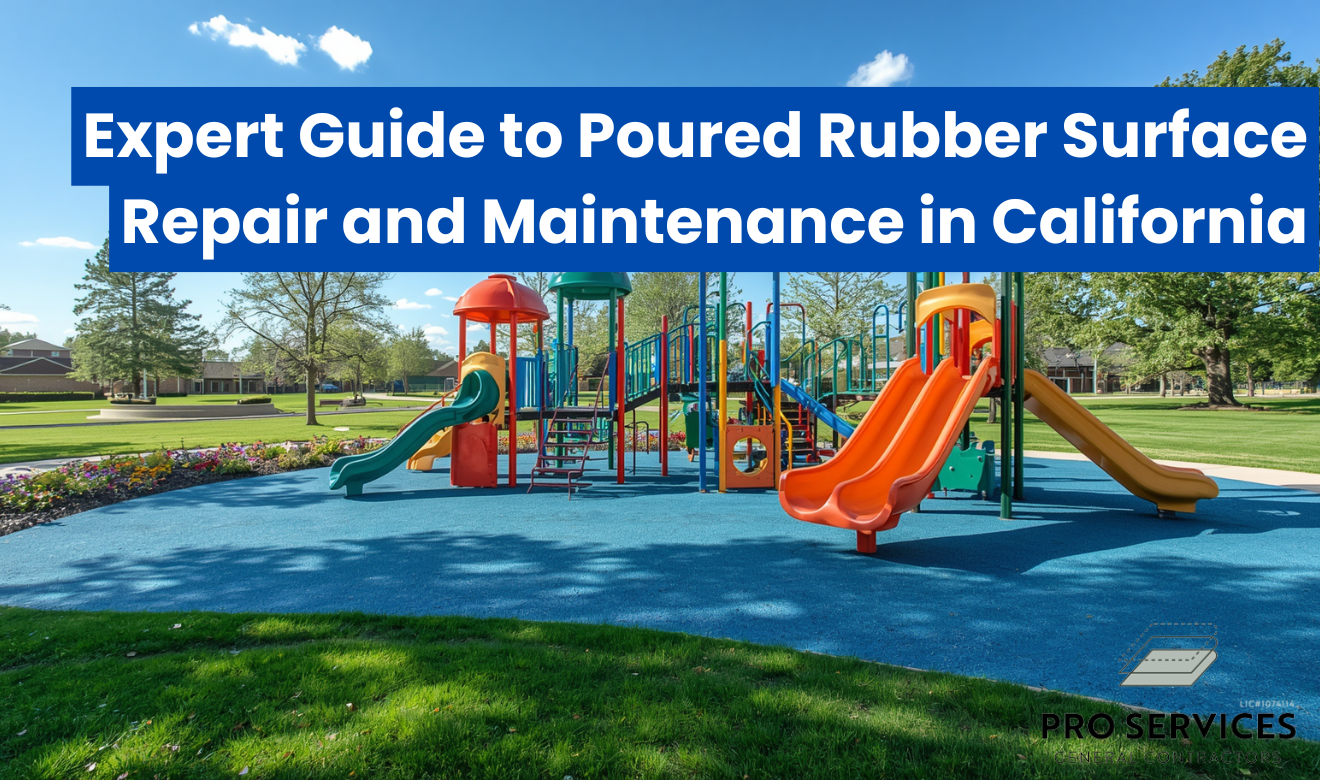
Expert Guide to Poured Rubber Surface Repair and Maintenance in California
Executive Summary
Poured rubber surface repair and maintenance in California is successful when it restores measurable safety performance, permanent adhesion, and water-shedding continuity by fixing the root cause (movement, moisture, UV) and rebuilding defects with proper edge prep, priming, and compatible rubber. A climate-matched inspection-and-repair plan—paired with documentation and timely topcoats—prevents repeat failures, closures, and compliance exposure.
Core Insights
- Repair the Cause, Not the Symptom: Split seams, cracking, and delamination recur unless crews remove failed material to sound edges, control moisture, and rebuild with compatible primers/binders rather than applying cosmetic sealants or “patch-over-patch” fixes.
- Verify Against Real Performance Expectations: “Good repair” is defined by flush, trip-free transitions, reliable drainage, and maintained safety/accessibility performance commonly referenced through ASTM F1292 (impact), ASTM F1951 (accessibility), ASTM F1487 (equipment/surfacing context), and ADA/CBC route obligations.
- Match Maintenance to California Microclimates: Coastal fog/salt air drives oxidation and algae so sealing, cleaning, and recoats are critical, inland heat drives shrinkage and seam separation so joint detailing and transition checks matter most, and mountain/high desert freeze-thaw demands early crack sealing, slope correction, and base stabilization.
Poured rubber surface repair and maintenance is the process of restoring and protecting seamless, impact-attenuating rubber surfacing so it stays safe, compliant, and durable in California conditions. It typically targets split seams, edge curl, surface cracking, low spots, and UV-chalked top layers on playgrounds, pool decks, dog parks, and schoolyard running lanes. In coastal cities like San Diego, Santa Monica, and Monterey, salt air and morning fog accelerate binder oxidation and leave the surface brittle, so repairs often include saw-cutting clean edges, removing delaminated rubber, priming, and installing a new pour-in-place patch that is troweled flush. In inland heat zones like Sacramento, Riverside, and the San Fernando Valley, summer surface temperatures drive shrinkage and seam separation, so maintenance commonly includes joint re-bonding, selective re-topping, and drainage checks around concrete curbs and utility lids. In mountain and high-desert areas like Big Bear, Tahoe, and the Antelope Valley, freeze-thaw cycles and snowmelt runoff can open hairline cracks and create birdbaths, so crews focus on slope correction, base stabilization, and water-shedding transitions at ramps and edges. A complete plan also includes routine inspections for trip hazards at transitions, depth checks in fall zones, spot cleaning to reduce algae in shaded courtyards, and timely topcoat renewal to slow UV fade and keep traction consistent.
What “Good Repair” Means for Poured Rubber in California
Effective restoration is defined by measurable safety performance, secure adhesion to the base, and a surface that drains without creating trip hazards. In practice, that means fixing the cause (movement, water, UV oxidation) and then rebuilding the rubber system so it remains seamless and impact-attenuating.
For playground settings, the repair standard is not visual perfection—it’s maintaining protective performance and accessibility. Industry evaluation commonly references the same regulatory framework used at installation time, including:
- ASTM F1292 for impact attenuation performance at the tested critical fall height (CFH).
- ASTM F1951 for accessibility/“wheelchair maneuverability” performance where applicable.
- ASTM F1487 as the performance standard for public playground equipment that ties use zones and surfacing expectations together.
- 2010 ADA Standards for Accessible Design (and California accessibility enforcement through CBC provisions) to manage vertical changes, transitions, and routes.
For a general overview of surface types and safety intent, see playground surfacing.
Common Failure Modes (and What They Usually Indicate)
Most poured rubber defects repeat in predictable patterns, and each pattern points to a specific root cause. Correct diagnosis prevents “patch-over-patch” repairs that fail again in one or two seasons.
- Split seams / open joints: thermal cycling, layout joints not detailed correctly, movement at concrete interfaces, or weak chemical bond at the seam.
- Edge curl / lifted perimeters: water intrusion at edges, poor restraint at curbs, or inadequate primer/bonding on vertical faces.
- Surface cracking (map cracking, hairlines): binder oxidation from UV exposure, cold embrittlement at altitude, or localized base movement.
- Low spots (“birdbaths”): base settlement, poor slope to drain, or trench patches that were not re-compacted.
- Delamination: moisture vapor pressure, contaminated substrate, or bond failure from improper priming and cure conditions.
- Chalking / color fade: UV degradation of the aliphatic or aromatic binder/top layer; often addressed with a compatible topcoat system.
- Hard spots: binder-starved mixes, wear-through to base mat, or patching with mismatched density/chemistry.
Inspection Protocol: What to Check and How to Document It
A consistent inspection routine identifies hazards early, when repairs are smaller and less disruptive. Documentation should be specific enough that an owner can prioritize work and verify completion.
Monthly walk-through checks (operations-level)
These checks focus on trip points, water problems, and obvious bond failures. The goal is to catch problems before they become claim-worthy hazards.
- Record location, dimensions, and photos of defects (include a ruler or tape for scale).
- Flag vertical displacement at transitions, edges, and utility lids.
- Look for standing water after irrigation cycles and after rain events.
- Check perimeters at curbs, ramps, and concrete mow bands for lifting.
- Inspect under swings and slide exits for abrasion, thinning, and hardening.
Quarterly technical checks (maintenance-level)
These checks verify functional performance: thickness in fall zones, drainage behavior, and early seam separation. When results are borderline, schedule targeted repairs before peak-use seasons.
- Depth checks in high-use/fall zones using core sampling only where acceptable to the owner and patchable immediately.
- Bond probing at suspicious edges (gentle lift test where already separated).
- Surface friction/traction observation in splash areas and shaded courtyards where algae can form.
- Drainage review around scuppers, deck drains, trench drains, and flush-mounted covers.
Post-repair verification (quality-control)
Verification confirms the repair is flush, adhered, and water-shedding. The key is ensuring a patch is not a new trip hazard or a water trap.
- Confirm patch edges are troweled flush with no lip.
- Confirm perimeter seal at curbs and penetrations is continuous (no pinholes or gaps).
- Flood-test (where appropriate) to confirm no birdbaths were created.
- Confirm cure time before opening to traffic per the product’s published instructions.
Repair Methods That Hold Up: Standard Procedures
Durable repairs follow a controlled sequence: isolate the defect, remove failed material, prepare clean edges, prime, and rebuild with compatible rubber. Skipping edge preparation or moisture control is the fastest way to repeat the same failure.
1) Seam separation and joint re-bonding
Seam repairs must re-establish a chemical and mechanical bond across the joint line. A cosmetic bead alone is not a structural seam repair and usually re-opens under heat cycling.
- Saw-cut or route a clean channel along the failed seam to remove oxidized/crumbly rubber.
- Remove delaminated material down to sound rubber and/or stable base.
- Dry and clean (vacuum dust; remove sand and oils).
- Prime with the system-compatible primer/binder per manufacturer instructions.
- Install pour-in-place seam mix and trowel tight, leaving no weak feather edge.
- Protect during cure (barricades, no irrigation overspray).
2) Patching cracks, holes, and delamination
Patch integrity depends on edge geometry and substrate soundness. The patch must be keyed into solid material, not tapered over degraded rubber.
- Square-cut the perimeter of the defect to create vertical edges (avoid thin “dish” patches).
- Verify base condition (no pumping, no loose aggregate, no saturated areas).
- Rebuild in lifts when thickness is significant (base layer then wear layer) to match the original system.
- Color-match expectations: new rubber typically appears darker until weathered; document this for owners.
3) Correcting low spots and drainage conflicts
Low spots should be corrected by restoring slope and stabilizing the base, not by repeatedly adding thin rubber layers. If water stays, oxidation accelerates and slip risk increases.
- Identify the water source: irrigation head overspray, deck drain backup, runoff path, or grade reversal.
- If settlement is present, remove rubber and repair the base (re-compact, re-grade, or replace unstable material).
- Re-install rubber to maintain a consistent plane to drains and edges.
- Detail transitions at ramps and curbs so water sheds away from bond lines.
4) UV restoration with recoats / topcoats
Recoating protects the binder from UV and can restore uniform traction when the surface is sound but chalked. Coating is not a substitute for fixing delamination, open seams, or base failures.
- Deep-clean to remove algae, sunscreen oils, and airborne contaminants.
- Repair defects first (seams, cracks, delamination, birdbaths).
- Apply the compatible topcoat system at the manufacturer’s specified spread rate and cure conditions.
- Re-open only after cure to avoid imprinting and premature wear.
Climate-Specific Maintenance in California (Coast, Inland, Mountain/Desert)
California’s regional climates change how poured rubber ages, so maintenance schedules should match local stressors. Aligning repair tactics to salt air, heat, or freeze-thaw is the difference between a 2-year and a 7-year maintenance cycle.
Coastal zones: salt air + marine layer
Coastal environments accelerate oxidation and keep surfaces damp longer, increasing brittleness and algae risk. Focus on bond-line sealing, cleaning, and timely topcoats.
- Prioritize edge restraint and perimeter sealing to stop water intrusion.
- Increase cleaning frequency in shaded courtyards to control algae and slippery biofilm.
- Plan recoats before the wear layer becomes porous and chalky.
Inland heat zones: high surface temps + shrinkage
Hot inland summers drive thermal movement that opens seams and stresses transitions at concrete. Focus on joint detailing, expansion interfaces, and drainage around hardscape.
- Inspect seams and terminations before and after peak heat months.
- Check around utility lids, curbs, and ramps where differential movement is concentrated.
- Verify irrigation schedules to avoid rapid wet/dry cycling on hot rubber.
Mountain and high desert: freeze-thaw + snowmelt runoff
Freeze-thaw exploits hairline cracks, and snowmelt can hold water against edges and ramps. Focus on crack control, slope correction, and base stability.
- Seal and patch early cracking before winter moisture enters the system.
- Improve water-shedding transitions at edges and ramps.
- Keep snow removal practices rubber-safe (avoid metal blades directly on the surface).
Compliance and Risk Control: What Owners Are Typically Held To
Public agencies, schools, and HOAs are judged on hazard response time and documented upkeep, especially where children or seniors use the space. Keeping records of inspections and completed work is a practical liability control.
- Playground safety expectations: ASTM F1292 impact performance is often used to evaluate whether surfacing still provides required attenuation for equipment fall heights.
- Accessibility expectations: the accessible route and surface conditions must remain navigable; abrupt changes in level and poorly detailed transitions create avoidable exposure.
- Slip resistance management: while specific coefficient-of-friction requirements vary by context and specification, owners can document cleaning and algae mitigation in wet/shaded zones as a defensible practice.
Core Metrics Table: Repair Triggers, Specifications, and California Field Notes
This table converts common site observations into actionable maintenance triggers. It helps align facilities staff, inspectors, and contractors on what “needs repair now” versus “monitor.”
| Feature / Metric | Specifications | Local Guidelines |
|---|---|---|
| Impact attenuation in fall zones | Evaluate to ASTM F1292 for the site’s critical fall height (CFH); retest after major repairs or re-topping in use zones. | For schools/parks, keep test reports with maintenance logs; prioritize swings, slide exits, and climber perimeters after summer and after storm seasons. |
| Accessibility / maneuverability | Assess accessibility performance where required using ASTM F1951; maintain firm, stable transitions on routes. | Document route checks at entries, ramps, and between surfacing types to align with ADA/CBC enforcement expectations. |
| Seam condition | Open seams, missing material, or split joint lines require saw-cut cleaning, priming, and compatible rubber rebuild (not just sealant). | In inland heat areas (e.g., Sacramento/Riverside), schedule seam review ahead of peak temperature months to prevent trip edges. |
| Drainage / standing water | Persistent birdbaths indicate slope/base issues; correct grade and base before resurfacing to avoid repeat failures. | In coastal fog belts and shaded courtyards, standing water increases algae risk—pair drainage correction with routine cleaning. |
| UV wear / chalking | Recoats/topcoats are appropriate when the surface is bonded and intact but oxidized; repair structural defects first. | In high-UV inland valleys and high desert, plan proactive recoats to avoid brittle cracking and accelerated abrasion. |
When to Repair vs. Re-Top vs. Replace
The correct scope depends on whether the system is structurally sound and whether the base is stable and draining. Choosing the right level of work controls lifecycle cost and reduces closures.
Repair (localized) is appropriate when:
Localized repairs work when failures are isolated and the surrounding rubber is well-bonded and resilient. The objective is to restore continuity without changing the entire surface.
- Seams are split in limited runs and the base is dry and intact.
- Cracks are confined and not tied to widespread embrittlement.
- Delamination is spot-specific (often at edges or penetrations).
Re-top (selective or full) is appropriate when:
Re-topping addresses uniform wear, oxidation, and traction loss while keeping the base mat if it remains compliant and bonded. This is often the best option when many small defects are present but the structure is still viable.
- Wear layer is chalked/faded and abrasion is widespread.
- Multiple small repairs would create a patchwork surface with inconsistent texture.
- Impact performance needs to be refreshed without full removal (subject to testing/verification).
Replacement is appropriate when:
Replacement is necessary when the base is unstable, the rubber is broadly delaminated, or performance cannot be restored reliably with overlays. Skipping replacement in these cases typically results in recurring failures.
- Widespread delamination indicates systemic bond failure or moisture problems.
- Base shows settlement, pumping, or repeated birdbaths after correction attempts.
- Surface has hardened broadly (loss of resilience), especially in key fall zones.
Routine Care That Extends Service Life (Without Damaging the Surface)
Simple, repeatable cleaning and protection steps prevent premature oxidation and slip hazards. The key is using methods compatible with polyurethane-bound rubber and avoiding aggressive abrasion.
- Dry debris removal: blow or sweep to remove sand and leaf litter that acts like sandpaper under foot traffic.
- Spot cleaning: treat shaded algae areas early; rinse thoroughly to avoid residue that attracts dirt.
- Avoid harsh tools: no metal scrapers, aggressive wire brushes, or high-pressure washing that can erode the wear layer and open pores.
- Control irrigation: adjust heads to prevent constant wetting at edges and transitions.
For porous systems and cleaning cadence ideas that translate well to rubber pavements, see how to maintain your porous rubber surface pavement.
Planning Work: Access, Safety, and Schedule Controls
Well-planned repairs reduce downtime and prevent rework caused by moisture, traffic, or cure interruption. The practical controls are barricading, cure windows, and clear sequencing with other trades.
- Site access: define staging areas so materials are not mixed over finished surfaces.
- Weather controls: avoid installation during rain events, heavy fog periods, or when substrate moisture is present; follow product cure limitations.
- Public safety: hard barricades and clear signage; do not allow partial access when seams are open or tacky.
- Interface coordination: schedule concrete, plumbing, and irrigation repairs before rubber patching to avoid saw-cutting new work.
Service Pathways for Owners Managing Multiple Sites
Multi-site owners benefit from standardizing inspections, repair details, and testing documentation across parks, campuses, and schools. A consistent scope reduces surprises and makes budgeting predictable.
- Bundle assessments with scheduled maintenance using a dedicated PIP maintenance program to keep seams, edges, and wear layers from reaching failure thresholds.
- Align playground repairs with any upcoming equipment changes so surfacing and fall zones remain coordinated.
Keeping Rubber Surfaces Safe, Compliant, and Looking Uniform
Long-lasting poured rubber performance comes from correcting root causes—water, movement, and UV—then restoring seamless continuity with compatible materials and documented quality control. In California, the most reliable results come from climate-specific planning: seal and clean more in coastal fog belts, reinforce seams and transitions in inland heat, and prioritize crack and drainage control in freeze-thaw regions.
Owners who pair routine inspections with timely seam repair, slope correction, and scheduled recoats consistently reduce closures and extend service life while staying aligned with ASTM impact/accessibility expectations and accessibility route obligations.
Frequently Asked Questions
Don’t Let a Small Rubber Surfacing Defect Turn Into a Closure, Claim, or Compliance Problem
Split seams, curled edges, birdbaths, and chalked wear layers don’t stay “minor” for long—especially in California. Coastal moisture and salt air accelerate brittleness and algae slicks, inland heat pulls seams apart, and freeze-thaw regions turn hairline cracks into water-driven delamination. The longer you wait (or the more you “quick patch” it), the more likely you are to end up with trip hazards, drainage traps, inconsistent impact performance in fall zones, and accessibility issues at transitions—exactly the kind of preventable conditions that drive complaints, inspections, and liability exposure.
Trying to handle poured-in-place rubber repairs with general-purpose crews or off-the-shelf materials is where most sites get burned. Without the right diagnosis and sequence—clean saw-cuts, proper edge geometry, moisture control, compatible priming/binders, and a patch that’s rebuilt to the correct thickness and troweled truly flush—repairs can re-open in one hot season, peel at the perimeter after foggy mornings, or create new lips and low spots that become the next hazard. Even worse: patch-over-patch work can leave a surface that looks “fixed” but behaves unpredictably where it matters most—at swings, slide exits, and high-traffic routes.
If you’re responsible for a school, park, HOA, or multi-site facility, you need repairs that hold up under real use and real weather—done by a team that understands local conditions, drainage conflicts, cure windows, and the performance expectations tied to playground surfacing and accessible routes. Get a clear scope, documented findings, and repairs that restore seamless continuity instead of masking the symptoms.
Related Posts

Expert Guide to Choosing the Best Rubber Playground Surface in San Diego, California
Executive Summary A rubber playground surface in San Diego is “safe” and durable only when…

The Ultimate Guide to Choosing Rubber Playground Surfaces in Orange County, California
A rubber playground surface in Orange County should be selected and accepted based on documented,…
Leave a Reply