
Benefits of ADA Compliant Poured in Place Rubber Surfacing in Orange County, California
Executive Summary
ADA-compliant poured-in-place (PIP) rubber surfacing in Orange County helps create firm, stable, slip-resistant routes that support mobility devices while also improving fall protection in play areas. Long-term ADA performance depends on system-level planning—base prep, drainage, slopes, transitions, thickness, and ongoing maintenance—not just the surface material.
Key Takeaways
- ADA compliance is performance-based, not automatic: PIP rubber can meet accessibility needs when designed and installed to remain firm, stable, slip-resistant, and connected to compliant routes.
- Unitary surfacing improves long-term accessibility: Unlike loose-fill materials that shift and rut, poured-in-place rubber stays continuous and navigable under traffic, reducing trip hazards and maintenance rework.
- Design details determine real usability: Proper slopes/cross-slopes, smooth transitions at borders, and effective drainage prevent pooling, lips, and wear that can undermine accessibility over time.
- Safety and access can be engineered together: Layered PIP systems can be specified for impact attenuation (fall-height protection) while still supporting wheelchair-friendly circulation paths.
- Cost is driven by site conditions and specifications: Budget depends on thickness, base condition, demolition/removal, access constraints, drainage upgrades, and the complexity of colors/patterns and detailing.
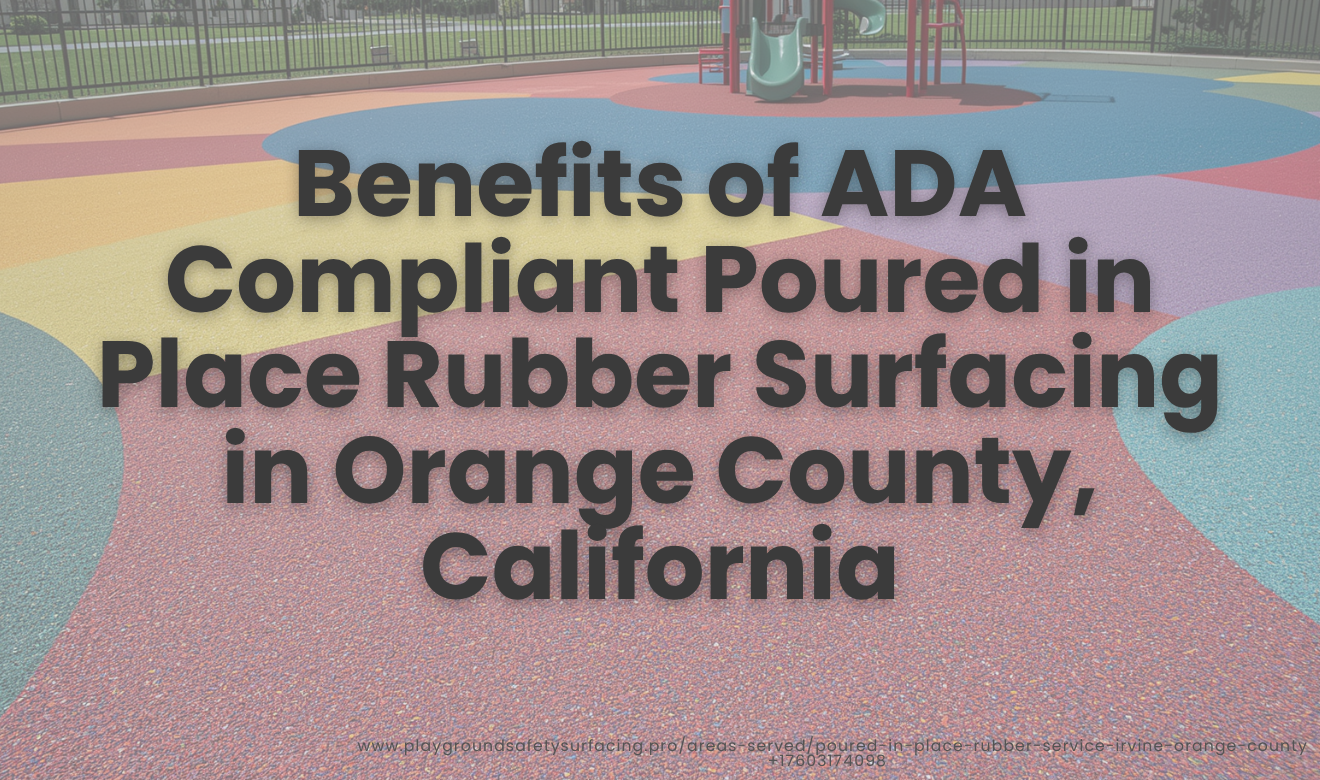
ADA compliant poured in place rubber Orange County surfacing makes outdoor spaces safer, more inclusive, and easier to navigate for everyone. It creates a smooth, wheelchair-friendly path across playgrounds, parks, and schoolyards, while also adding impact absorption to help reduce injuries from falls. For example, a playground in Irvine can use poured-in-place rubber to keep routes accessible from the parking area to the play structures, and a park in Santa Ana can use it to create stable walking surfaces that don’t turn uneven after heavy foot traffic. It also helps reduce trip hazards compared to loose-fill options like wood chips, and it can be installed in bright colors or patterns to clearly mark play zones, ramps, and gathering areas.
What “ADA Compliant” Means for Poured-In-Place Rubber in Orange County
When people search for ADA compliance poured in place rubber Orange County, they’re usually trying to confirm one thing: will the surface actually work for wheelchair users, walkers, strollers, and anyone who needs a stable, navigable route?
In practical terms, ADA-compliant surfacing aims to provide:
- Firm, stable, and slip-resistant routes that are easier to travel over with mobility devices
- Consistent accessibility across high-traffic areas (not just immediately after installation)
- Reduced tripping risks compared to loose-fill materials that shift or rut over time
Poured-in-place (PIP) rubber is commonly selected for ADA compliance poured in place rubber Orange County projects because it creates a seamless surface that can be designed around accessible paths, ramps, and play features.
How Poured-In-Place Rubber Supports Accessibility (Beyond “Smooth”)
Accessibility isn’t only about being smooth—it’s about staying usable after weather, foot traffic, and play. A key advantage of ADA compliance poured in place rubber Orange County installations is that the surface doesn’t scatter like engineered wood fiber (EWF) or kick out like some loose-fill materials.
Key accessibility benefits
- Continuous routes: easier to connect parking, sidewalks, gates, restrooms, and play zones
- Predictable traction: reduced wheel slippage compared with materials that shift under load
- Edge-to-edge transitions: curbs and trip points can be minimized with proper detailing
- Clear wayfinding: colors and patterns can highlight accessible routes, ramps, and gathering areas
For planners working on ADA compliance poured in place rubber Orange County upgrades, the biggest win is that accessibility is “built in” rather than constantly restored through raking and top-offs.
What Standards and Guidelines Typically Apply
Most accessibility discussions around ADA compliance poured in place rubber Orange County relate to how the surface performs under mobility devices and whether accessible routes are provided to key site amenities.
Commonly referenced considerations include:
- ADA Standards for Accessible Design (for accessible routes, slopes, and transitions)
- ASTM standards for playground safety related to impact attenuation (often required in play areas)
- Local code and agency requirements (which can vary by city and project type)
It also helps to understand how the surface type fits into broader playground safety categories. A quick overview of common materials and types is summarized in general references on playground surfacing.
Why Poured-In-Place Rubber Can Reduce Injury Risk from Falls
Falls are a leading source of nonfatal injuries for children. The U.S. Centers for Disease Control and Prevention (CDC) notes that emergency departments treat millions of children each year for injuries, with falls as a major contributor. On playgrounds, surfacing is one of the most controllable risk factors.
That’s why ADA compliance poured in place rubber Orange County projects often focus on two outcomes at once:
- Accessibility (wheelchair and mobility-device navigation)
- Impact attenuation (shock absorption under and around play equipment)
Because poured-in-place rubber is installed in layers and can be engineered to meet specific fall-height needs, it’s commonly used in areas where both inclusive access and injury reduction matter—like schools, public parks, and community centers.
How Design Choices Affect ADA Compliance in Poured-In-Place Rubber
Not every rubber surface automatically equals ADA compliance poured in place rubber Orange County. The details matter. Even a high-quality surface can become difficult to navigate if the design overlooks transition points or drainage.
Design details that influence accessibility
- Slope and cross-slope planning: accessible routes should avoid steep grades and pooling water
- Transitions at borders: edges at concrete, turf, or unitary surfaces should minimize abrupt lips
- Drainage strategy: standing water can reduce traction and shorten surface life
- Color contrast: patterns can support visual navigation for users with low vision
- Layout of routes: ensure an accessible path connects key features (parking, entrances, play components)
If your goal is ADA compliance poured in place rubber Orange County, it helps to plan the route network first, then design the surfacing thickness, borders, and transitions around those paths.
Cost: What Impacts Pricing for ADA Compliant Poured-In-Place Rubber in Orange County?
Pricing for ADA compliance poured in place rubber Orange County projects varies widely based on site conditions and performance requirements. Instead of focusing on a single number, it’s more useful to understand what drives the budget.
Main cost drivers
- Surface area and thickness (thicker systems are often needed for higher fall-height protection)
- Base preparation (grading, concrete/asphalt condition, drainage improvements)
- Site access (tight access can increase labor time and staging complexity)
- Color and pattern complexity (graphics, logos, multi-color zones, striping)
- Removal and disposal (demolition of old surfacing or failed base layers)
- Project scheduling (after-hours work or compressed schedules can add cost)
For budget planning, it’s also worth weighing long-term ownership costs. Some lower-cost choices can require frequent replenishment or leveling. For a helpful perspective on lifecycle value, see why cheap surfacing costs more long term.
What to Expect During Installation (Timeline + Site Impacts)
Most ADA compliance poured in place rubber Orange County installations follow a predictable workflow, but the schedule depends on weather, base readiness, and cure times.
Typical installation phases
- Site evaluation and measurement: confirm dimensions, slopes, and transitions
- Base prep: repair or install the sub-base to support a stable, long-lasting system
- Mixing and placing layers: the base layer is installed first, then the wear layer
- Detailing edges and transitions: ramps, curbs, and borders are finished to reduce trip points
- Cure and reopen: reopening depends on curing conditions and manufacturer guidance
If you’re comparing approaches and want a clear overview of the service itself, explore Poured In Place Rubber to see common applications and planning considerations.
Where ADA Compliant Poured-In-Place Rubber Works Best in Orange County
In real projects, ADA compliance poured in place rubber Orange County is often prioritized in the areas where “access breaks down” most easily—places where loose-fill migrates, or where heavy use creates uneven ground.
High-value locations
- Playgrounds: accessible routes to play components and stable circulation paths
- Parks and recreation spaces: walking loops, exercise zones, and gathering areas
- Schoolyards: high traffic plus safety requirements under play equipment
- Community and senior centers: stable, slip-resistant routes for mobility devices
- Courtyards and shared-use spaces: clear zone marking and easy maintenance
These use cases are exactly why ADA compliance poured in place rubber Orange County is frequently selected for municipal and school modernization efforts: it supports both inclusive access and consistent day-to-day usability.
Maintenance: How to Keep Poured-In-Place Rubber Accessible Over Time
Long-term performance is a major part of ADA compliance poured in place rubber Orange County. A surface that starts out smooth but becomes cracked, separated, or uneven can create new barriers.
Practical maintenance checklist
- Regular sweeping or blowing to remove sand and debris that can reduce traction
- Rinse as needed in dusty or high-pollen areas to keep pores and texture clean
- Inspect seams and transitions at concrete edges, drains, and ramps
- Address small damage early (minor repairs help prevent larger failures)
- Monitor drainage so water doesn’t pool and degrade the wear layer
With routine upkeep, ADA compliance poured in place rubber Orange County surfaces can stay stable and navigable through heavy use—one of the main reasons agencies prefer unitary surfaces in high-traffic routes.
Common Mistakes That Can Undermine ADA Compliance
Even when the right material is selected, ADA compliance poured in place rubber Orange County can be compromised by planning or execution issues that show up months later.
Pitfalls to avoid
- Installing over a failing base (cracks and movement telegraph through)
- Poor drainage planning (leads to pooling, algae, and premature wear)
- Ignoring transitions at curbs, headers, and adjacent pavements
- Overly complex graphics in high-wear zones without considering maintenance and UV exposure
- Not defining accessible routes first (then “hoping” access works out afterward)
A reliable approach is to treat ADA compliance poured in place rubber Orange County as a system—sub-base, drainage, thickness, and route layout—not just a top layer.
Real-World Planning Examples (Orange County Use Cases)
Here are practical ways ADA compliance poured in place rubber Orange County is applied to solve everyday access problems:
- School modernization: creating a continuous, wheelchair-friendly route from drop-off areas to play zones while also improving fall protection under equipment.
- City park upgrades: replacing loose-fill areas that rut and drift with a unitary surface that stays even after events, weekend crowds, and maintenance vehicles.
- Inclusive play projects: using high-contrast color bands to guide movement between sensory areas, swings, and quiet zones—improving navigation for more users, not just wheelchair riders.
In each case, the goal is the same: ADA compliance poured in place rubber Orange County that remains consistent after the grand opening—when the real test begins.
Built for Access, Built to Last
If you’re planning a playground, park, or schoolyard upgrade, ADA compliance poured in place rubber Orange County is one of the most practical ways to combine inclusive access with dependable safety performance. The best outcomes come from pairing smart route planning, proper base preparation, correct thickness for fall heights, and a maintenance plan that keeps the surface firm, stable, and slip-resistant.
From an industry standpoint, strong project teams lean on established ADA design principles, ASTM playground safety benchmarks, and field-proven installation practices—because accessibility isn’t a feature you add later. It’s something you build into every layer.
Frequently Asked Questions
Ready for an ADA-Friendly Surface That Actually Holds Up?
If you’re planning an upgrade in Irvine, Santa Ana, or anywhere in Orange County, don’t settle for a surface that looks great on day one and turns into a maintenance headache later. Orange County Poured in Place Rubber Pros LLC installs ADA-compliant poured-in-place rubber designed for real-world traffic—smooth, stable, slip-resistant, and built with the right base prep, drainage, transitions, and fall-height protection in mind. Want a clear plan (and a clear quote) for your playground, park, or schoolyard? Reach out and let’s map out an accessible surface that stays accessible.
Related Posts

The Ultimate Guide to Choosing Playground Surfacing in San Diego, California
Executive Summary Compliant playground surfacing in San Diego County means selecting and installing a surfacing…

Expert Guide to the Best Playground Surfacing Options in Orange County, California
Executive Summary Playground surfacing in Orange County should be selected and specified based on verified…
Leave a Reply