
Poured in Place Rubber vs Rubber Tiles: Which is Better for San Diego, California Playgrounds?
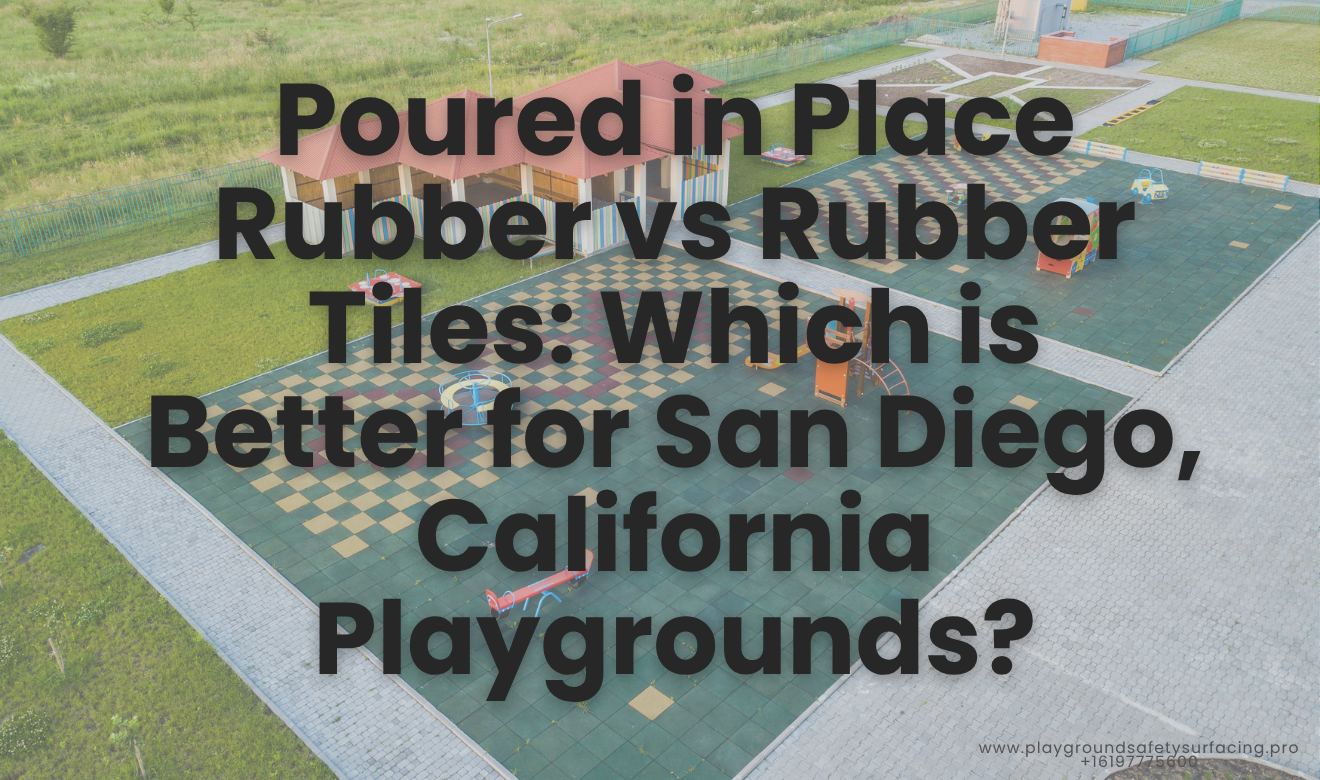
If you’re choosing between poured-in-place rubber and rubber tiles for a San Diego playground, poured-in-place rubber is usually the better all-around option for safety, accessibility, and long-term performance, while rubber tiles can be a practical choice for faster installs and smaller areas. In the poured in place rubber vs rubber tiles San Diego debate, the biggest difference is how they handle seams, drainage, and heavy use. For example, poured-in-place creates a smooth, seamless surface that works well for wheelchairs and strollers and reduces trip edges around slides and swings. Rubber tiles, on the other hand, can be replaced one section at a time if a spot gets damaged, which can be helpful under a single swing bay or in a compact daycare play zone.
Poured in place rubber vs rubber tiles San Diego: what matters most for real-world playgrounds
When people compare Poured in place rubber vs rubber tiles San Diego, they’re usually trying to answer one practical question: “Which surface will stay safe, look good, and hold up with the least headaches?” In San Diego, that answer depends on how the playground is used (public park vs preschool vs HOA), the sub-base condition, sun exposure, and how strict you need to be about accessibility and trip hazards.
Below is a clear, decision-focused breakdown of Poured in place rubber vs rubber tiles San Diego, including safety standards, drainage, maintenance, and cost-of-ownership—written to match what most buyers actually need to know before they spec a surface.
Quick comparison: poured-in-place rubber vs rubber tiles
| Category | Poured-in-place rubber (PIP) | Rubber tiles |
|---|---|---|
| Seams & trip risk | Seamless, lowest trip-edge risk | Seams can lift/curl over time if not perfectly adhered |
| Accessibility (ADA) | Excellent for mobility devices and transitions | Good when installed well; seams can affect rolling resistance |
| Drainage | Can be porous; depends on system and base prep | Depends on tile type and adhesive; water can migrate to seams |
| Repairs | Patchable, but color matching can be noticeable | Individual tiles can be replaced (fast, localized) |
Safety first: impact attenuation and fall-height performance
In the Poured in place rubber vs rubber tiles San Diego discussion, safety should be measured by more than “it feels soft.” Playground surfacing is commonly evaluated for impact attenuation (how it reduces head injury risk) and for compliance with recognized testing methods. The real performance is determined by:
- Thickness matched to equipment fall height (slides, climbers, overhead events)
- Condition of the sub-base (settlement and cracking change impact behavior)
- Material quality (binder content, rubber gradation, UV stability)
- Ongoing maintenance (wear layers can thin in heavy-use zones)
Both systems can be built to meet safety needs when correctly specified and installed. However, poured-in-place tends to keep its “designed performance” more consistently because there are no independent tiles that can shift, gap, or curl—an important point in Poured in place rubber vs rubber tiles San Diego comparisons for busy public parks.
If you want a broader overview of surfacing types and why they’re regulated and tested, it helps to understand the general categories of playground surfacing and how each is intended to reduce injuries.
Accessibility and compliance: why seamless often wins
For many San Diego sites—city parks, schools, inclusive playgrounds, and senior-adjacent recreation spaces—accessibility isn’t optional. When evaluating Poured in place rubber vs rubber tiles San Diego, consider what happens over time, not just day one.
Why poured-in-place rubber is typically more accessible
- No seams to catch wheels, canes, or toes
- Smoother transitions around ramps, borders, and equipment footers
- More consistent rolling for wheelchairs and strollers
- Better integration with curbs, concrete walks, and accessible routes
When rubber tiles can still work well
- Small, low-traffic play areas with limited equipment fall zones
- Projects where rapid installation is the top priority
- Indoor or covered spaces where UV and weather cycles are less aggressive
This is one of the clearest “separation points” in the Poured in place rubber vs rubber tiles San Diego decision—especially if you’re responsible for compliance, inspections, or risk management.
Seams, edges, and movement: where tiles can struggle in coastal conditions
San Diego’s coastal air, sun exposure, and temperature swings can be tough on adhesives and seams if prep isn’t perfect. In the Poured in place rubber vs rubber tiles San Diego debate, seams are the defining maintenance variable because:
- Edges can curl if adhesive coverage is insufficient or moisture is present in the slab.
- Seams can open as the base expands/contracts or if the slab cracks.
- Sand and debris can accumulate along joints, increasing wear.
Poured-in-place rubber reduces these risks by forming one monolithic surface that moves more uniformly with the base (though base cracks and drainage issues can still telegraph through if not addressed).
Drainage: porous systems and why base prep matters more than the surface type
Buyers often ask which drains better in Poured in place rubber vs rubber tiles San Diego. The honest answer: drainage is primarily a system design issue (surface + base + slope), not just the top layer.
Poured-in-place drainage notes
- PIP can be installed as a porous rubber surface so water moves through the material.
- The base must be built to accept water and move it away (proper slope, compatible stone layer, and perimeter drainage as needed).
Rubber tile drainage notes
- Some tiles are designed with drainage channels; others rely on seams and the substrate slope.
- If water gets trapped under tiles on an impermeable slab, you may see odor, adhesive failure, or mold risk depending on conditions.
If drainage and permeability are top priorities for your site, it’s worth reviewing Porous Rubber Surfaces options to understand how porous systems are engineered for water movement—this is often the “tie-breaker” detail in Poured in place rubber vs rubber tiles San Diego projects with pooling or irrigation overspray.
Durability under heavy use: swings, slide exits, and high-traffic paths
High-wear areas are where the Poured in place rubber vs rubber tiles San Diego comparison becomes very real. Most playground damage doesn’t happen evenly—it concentrates in specific zones:
- Under swing bays (repetitive scuffing)
- At slide exits (hard heel strikes and turning)
- At spinner entry/exit points
- Along “desire paths” (kids and caregivers walking the same lines daily)
How poured-in-place handles wear
- Wears as a continuous field—no individual pieces to shift
- Can be designed with thicker sections in high-fall zones
- Repairs are possible, but aesthetics depend on matching aggregate and color
How tiles handle wear
- Damaged areas can be swapped out tile-by-tile
- But repeated edge stress can cause seam fatigue if the base isn’t perfectly flat
For busy parks and school campuses, poured-in-place usually wins the long game in the Poured in place rubber vs rubber tiles San Diego evaluation.
Installation timelines: what “faster” really means
Rubber tiles are often marketed as a fast solution, and in some cases they are. But timelines depend on substrate readiness and site constraints.
Rubber tiles are typically faster when:
- You’re installing over an existing slab in good condition
- The layout is simple (few curves, borders, or custom graphics)
- The work area is small (daycare yard, compact tot lot)
Poured-in-place is typically smoother when:
- You need curves, ramps, or fully integrated transitions
- You want custom color patterns without seam interruptions
- You’re building for long-term public use and inspections
For projects where performance and compliance matter as much as schedule, many owners lean toward a dedicated Poured In Place Rubber Installation San Diego approach to ensure the base, thickness, and finish are engineered as one complete system—an approach that often reduces lifecycle issues in Poured in place rubber vs rubber tiles San Diego comparisons.
Maintenance expectations: what you’ll actually be doing year to year
Maintenance is where budgets get surprised. In Poured in place rubber vs rubber tiles San Diego, both surfaces are “low maintenance” compared to loose fill, but neither is “no maintenance.” Plan for:
- Regular cleaning (blowing debris, gentle washing, spot cleaning organic material)
- Inspections for thinning, cracking, seam changes, and trip edges
- Drainage checks after storms or irrigation adjustments
Typical maintenance differences
- Poured-in-place: fewer edge/seam issues; occasional patching; may need recoating in high-UV, high-use environments depending on system design.
- Tiles: more frequent seam/adhesive monitoring; individual tile replacements are straightforward; keep an eye on corners and perimeters.
If you’re trying to avoid the “cheap now, expensive later” trap, the same logic applies here as it does with many playground materials. The long-term cost mechanics are similar to what’s discussed in why cheap surfacing costs more long term—especially when repairs, closures, and rework start adding up.
Total cost of ownership in San Diego: what drives pricing up or down
People often expect a simple price answer, but in reality, the Poured in place rubber vs rubber tiles San Diego cost difference comes down to site conditions and specs. The biggest cost drivers include:
- Square footage and geometry (curves and tight cut-ins increase labor)
- Required fall-height rating (more thickness = more material)
- Sub-base condition (repairs, grading, drainage corrections)
- Design elements (color EPDM caps, patterns, game lines)
- Access constraints (hand-carry, limited staging, school-hour restrictions)
As a planning rule: tiles can appear less expensive upfront for very small installations, while poured-in-place frequently provides better value for larger areas because it reduces seam-related risk and often performs more consistently under heavy use—one of the core reasons Poured in place rubber vs rubber tiles San Diego decisions lean toward PIP for municipal work.
Best-fit recommendations by site type (San Diego examples)
If you’re still weighing Poured in place rubber vs rubber tiles San Diego, use the site type as your filter.
Public parks and municipal sites
- Best fit: poured-in-place rubber
- Why: seamless accessibility, fewer trip points, better continuity for inspections, and stronger performance in high-traffic areas
Schools, preschools, daycares, churches
- Best fit: poured-in-place for main play zones; tiles can work in small, contained areas
- Why: supervision and mobility access benefit from a smooth surface; localized replacement can be useful where wear is concentrated
HOAs, apartments, and compact tot lots
- Best fit: depends on size and base
- Why: if the area is small and the base is stable, tiles can be practical; for higher-end amenities and long-term curb appeal, PIP usually wins the Poured in place rubber vs rubber tiles San Diego comparison
Rooftops, decks, and podiums
- Best fit: system-dependent; professional design required
- Why: waterproofing interfaces, drainage design, and load considerations matter as much as the surface choice
Common spec mistakes to avoid (the things that cause callbacks)
Most problems blamed on “rubber surfacing” are actually preventable spec or prep issues. In Poured in place rubber vs rubber tiles San Diego, watch for these repeat offenders:
- Ignoring slope/drainage and assuming the surface alone will “fix” water
- Installing over a failing base (cracking slabs, soft spots, poor compaction)
- Under-building thickness for the real fall heights
- Not planning for wear zones under swings and at slide exits
- Skipping maintenance planning (no cleaning schedule, no inspection routine)
When you avoid these issues, both systems perform better—but poured-in-place tends to be more forgiving in daily use, which is a big reason it often wins the Poured in place rubber vs rubber tiles San Diego decision for long-term ownership.
Built to Last in San Diego: the smart pick for your playground
If your priority is a smooth, wheelchair-friendly surface with fewer trip hazards and strong performance under heavy use, poured-in-place rubber is usually the best answer in the Poured in place rubber vs rubber tiles San Diego comparison. If your project is small, needs a fast turnaround, or you want simple tile-by-tile replacement in a contained area, rubber tiles can still be a practical solution—especially when the substrate is perfectly stable and drainage is already solved.
Whichever route you choose, long-term results come down to professional system design: correct fall-height thickness, proper base preparation, and a maintenance plan that fits how the space is actually used. Teams that specialize in playground safety surfacing typically work to industry-recognized practices for impact performance and accessibility, and they plan installations around real San Diego conditions—UV exposure, coastal moisture, and high year-round playground traffic—so the surface performs beyond the ribbon cutting.
Frequently Asked Questions
Ready to Choose the Right Playground Surface for San Diego?
If you’re still weighing poured-in-place rubber vs rubber tiles, the fastest way to get to a confident decision is to match your fall-height needs, drainage realities, and ADA goals to the right system—before you spend a dollar on materials. Playground Safety Surfacing can help you compare options for your exact site, pinpoint the specs that actually matter (thickness, base prep, seams, and wear zones), and map out a plan that holds up to San Diego sun, coastal conditions, and daily traffic—without the surprise repairs later.
Related Posts

The Ultimate Guide to Rubber Playground Flooring in San Diego, California
Executive Summary Rubber playground flooring San Diego performs best when it is specified and installed…

Top Quality Rubber Playground Flooring Options in Orange County, California
Executive Summary Rubber playground flooring in Orange County performs best when specified and built as…
Leave a Reply