
Poured in Place Rubber vs Turf: Which is Better for Playgrounds in Orange County, California?
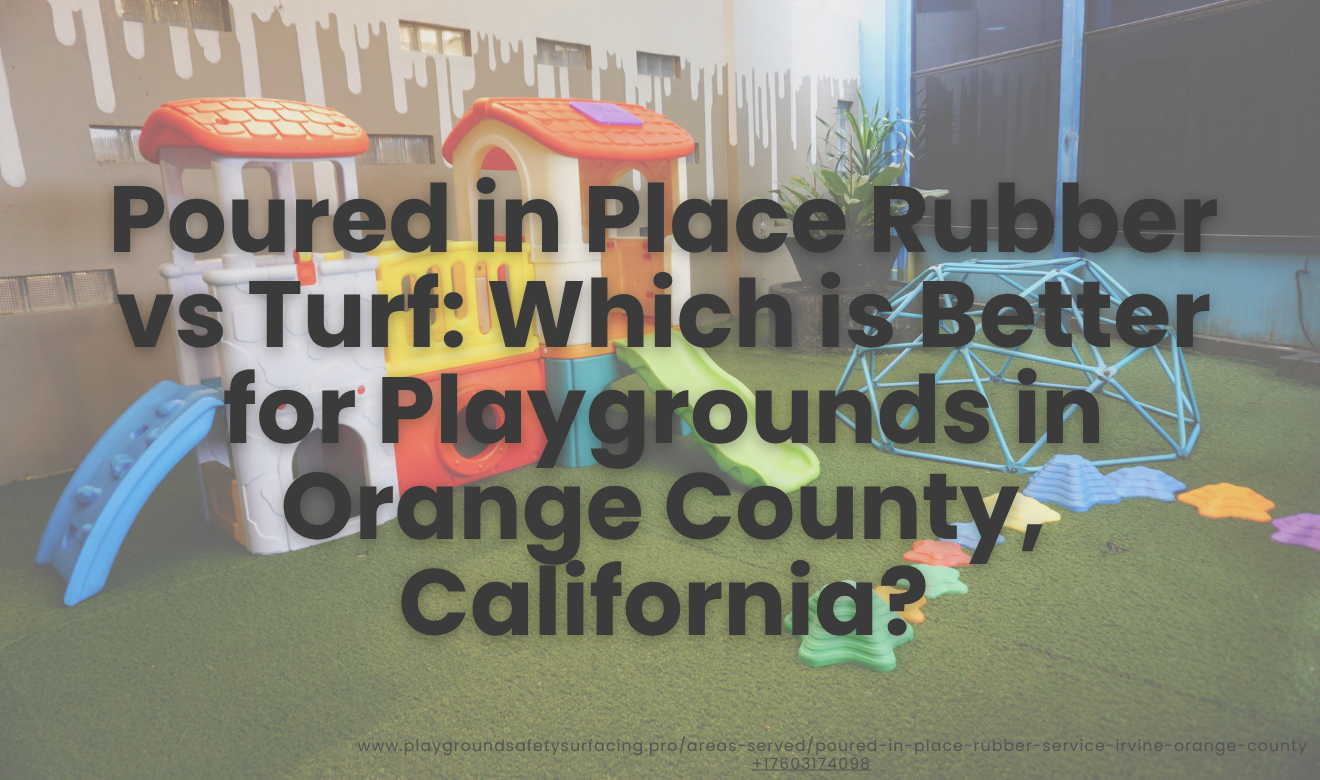
If you’re choosing between poured-in-place rubber and turf for a playground in Orange County, California, poured-in-place rubber is usually the better all-around option for safety, accessibility, and long-term performance, while turf can be a good fit when you want a natural look and lighter upfront cost. In this poured in place rubber vs turf Orange County comparison, the “best” choice depends on how the space will be used and maintained. For example, a busy school playground with lots of running, climbing, and wheelchair traffic often benefits from seamless rubber that won’t shift or create tripping edges. On the other hand, a smaller HOA play area that wants a lawn-like appearance may prefer turf, especially when paired with proper padding and good drainage. In coastal or inland heat, rubber can get warm in direct sun, while turf can also heat up and may need rinsing; adding shade structures is a concrete way many parks handle both surfaces.
Poured In Place Rubber vs Turf Orange County: Quick Answer for Busy Decision-Makers
If you need one surface that checks the most boxes for public-use play, poured-in-place (PIP) rubber usually wins in a poured in place rubber vs turf Orange County decision because it’s seamless, wheelchair-friendly, and consistently performs under heavy traffic. Turf can still be a smart choice when:
- you want a greener, lawn-like look,
- the play area is lower-use,
- and you’re committed to ongoing grooming/sanitizing to keep it performing well.
Either way, safety depends on proper design, correct fall-height protection, drainage, and maintenance—not just the surface type.
What “Safe Playground Surfacing” Means in California (and Why It Changes the Choice)
When families, schools, and cities compare poured in place rubber vs turf Orange County, they’re usually trying to reduce injury risk from falls while staying compliant with common guidelines for playground surfacing. In practice, “safe” typically includes:
- Impact attenuation (surface reduces head/arm/leg injury risk from falls)
- Accessibility (stable/firm routes for wheelchairs and mobility devices)
- Traction (lower slip risk when wet or dusty)
- Consistency over time (performance doesn’t depend on frequent re-leveling)
PIP rubber is designed to be installed at specific thicknesses to match equipment fall heights. Turf systems can also be built to meet fall protection, but they’re more dependent on correct pad selection, infill levels, and ongoing upkeep.
Side-by-Side Comparison: Poured Rubber vs Turf for Orange County Playgrounds
| Factor | Poured-In-Place Rubber | Playground Turf System |
|---|---|---|
| Accessibility | Excellent: seamless, no loose fill, stable for mobility devices | Good when well-installed; edges/seams and infill migration can reduce stability |
| Fall protection consistency | Strong: thickness is engineered to fall height | Varies: relies on pad + infill + grooming to stay consistent |
| Maintenance | Typically simpler: cleaning + periodic inspections/repairs | More frequent: brushing, debris removal, infill management, sanitizing |
| Appearance | Custom colors, graphics, games, logos | Natural “grass” look; can blend well with landscaping |
Safety and Fall Protection: Where PIP Rubber Usually Pulls Ahead
In most poured in place rubber vs turf Orange County evaluations, safety is the #1 driver—especially for schools and public parks. Here’s the practical difference:
Poured-in-place rubber safety strengths
- Seamless surface reduces trip edges and gaps
- Consistent impact protection because thickness is matched to play equipment fall height
- No loose infill to kick out, migrate, or expose hard spots
- Better for wheelchairs and strollers (stable, firm, smooth transitions)
Turf safety strengths (when built correctly)
- Soft, forgiving feel for general play and running
- Good drainage potential when base prep is done properly
- Lower glare / natural look in certain design contexts
The catch: turf performance depends heavily on the full system (base + pad + turf + infill) and on ongoing grooming to keep everything level and cushioned.
Accessibility (ADA-Friendly Design): A Major Reason Orange County Chooses PIP
If your playground needs to support inclusive play, the poured in place rubber vs turf Orange County comparison often comes down to how reliably each surface stays accessible year after year.
- PIP rubber: Typically excels because it’s seamless and doesn’t shift under turning wheels, walkers, or frequent foot traffic.
- Turf: Can be accessible, but seams, transitions, and infill movement can create rolling resistance or uneven spots if maintenance slips.
This is why higher-traffic sites—schools, city parks, and destination playgrounds—often lean toward rubber.
Orange County Climate Reality: Heat, Sun, and Coastal Air
Local climate matters in any poured in place rubber vs turf Orange County decision. Orange County has microclimates—coastal marine layers, inland heat spikes, Santa Ana winds—so surfaces face UV exposure, debris, and temperature swings.
Heat management (both surfaces can get hot)
- Poured rubber: Darker colors can warm up in direct sun; lighter colors can help.
- Turf: Can also heat up significantly; rinsing can temporarily cool it, but that adds water and labor.
One of the most reliable solutions for both is adding shade. If heat is a concern, integrating shade structures into the plan can dramatically improve comfort and playtime during warmer months.
Coastal moisture and drainage
- Both systems need a properly prepared base.
- Poor drainage is where surfaces fail early—odors, bacteria concerns, surface breakdown, or puddling.
If you’re near the coast, prioritizing drainage design and materials that handle moisture is just as important as picking between rubber or turf.
Maintenance and Cleaning: What Owners Actually Deal With
Maintenance is where many property owners feel the difference most after the install. When comparing poured in place rubber vs turf Orange County, ask: “What will my staff realistically do each week?”
Poured-in-place rubber typical maintenance
- Blow/sweep debris
- Periodic wash-down and spot cleaning
- Routine inspections for wear in high-use zones (entries, slide exits, swing bays)
- Small repairs to prevent water intrusion and edge breakdown
For a deeper look at what keeping rubber in top shape involves, planning around real-world upkeep expectations matters as much as the install.
Playground turf typical maintenance
- Remove leaves and debris (prevents drainage and odor issues)
- Brush fibers back upright (especially in high-traffic lanes)
- Monitor/maintain infill levels (to reduce compaction and hard spots)
- Sanitize as needed (especially for schools, daycares, and dog-adjacent areas)
If budget decisions are pushing you toward the lowest upfront bid, it’s worth understanding how “cheap now” can cost more later. A helpful reference is why cheap surfacing costs more long-term, especially for high-use playgrounds.
Durability and Life-Cycle Value: Upfront Cost vs Long-Term Performance
In a poured in place rubber vs turf Orange County decision, it’s easy to focus on initial price. But the better question is: Which surface will still be safe and attractive after years of hard use?
Why PIP rubber often delivers better long-term value
- Doesn’t rely on infill that can migrate, compact, or track out
- Stays in place (no wrinkling or shifting when properly installed)
- Repairable in sections (targeted fixes vs full replacement in some cases)
When turf can hold value well
- Lower-use spaces (small HOA tot lots, pocket parks)
- Sites with strong maintenance routines and staff support
- Projects where aesthetics and landscape integration are top priorities
Bottom line: for busy playgrounds, poured rubber tends to be the “set it and protect it” surface, while turf is more of a “maintain it to keep it performing” surface.
Best Fits by Property Type in Orange County
Different sites behave differently. Here’s a practical way to think about poured in place rubber vs turf Orange County by setting type:
Schools and high-traffic playgrounds
- Often best: Poured-in-place rubber (handles lines of kids, running paths, and mobility devices)
- Why: Seamless accessibility, fewer trip points, consistent fall protection
City parks and public works projects
- Often best: PIP rubber for inclusive play and heavy weekend use
- Why: Predictable performance with broad public use patterns
HOAs and apartment communities
- Could go either way: Turf for lawn-like look; PIP rubber for low liability and easy access
- Tip: Choose based on how often the area will be cleaned and inspected
Preschools and daycare play yards
- Often best: PIP rubber for hygiene-friendly cleaning and stable toddler footing
- Design tip: Add color zones for learning/play patterns
Design Flexibility: Colors, Graphics, and Play Value
A surprisingly important part of the poured in place rubber vs turf Orange County conversation is how the surface supports the overall play experience.
- PIP rubber: Great for hopscotch, number grids, pathway games, school logos, wayfinding, and themed playground graphics.
- Turf: Great for a natural park aesthetic, open play lawns, and landscape continuity.
For schools and inclusive playgrounds, those surface graphics can add real play value without adding new equipment.
Installation Quality: The “Hidden Variable” That Decides Outcomes
Many problems blamed on either material are actually installation issues: poor base prep, wrong thickness, bad drainage, or rushed curing times. In any poured in place rubber vs turf Orange County comparison, workmanship is the multiplier.
What to verify for poured-in-place rubber
- Proper sub-base and drainage plan
- Thickness designed for equipment fall height (not “one thickness everywhere”)
- Clean edges and transitions at concrete, ramps, and borders
- Correct mixing, placement, and curing conditions
What to verify for playground turf
- Engineered base for drainage and stability
- Shock pad selection suited to fall height requirements
- Seam integrity and perimeter anchoring
- Infill type and correct installation depth
If you’re leaning toward rubber and want to understand options, specs, and how it’s built for playground environments, explore Poured In Place Rubber to see how the system is typically applied across different play settings.
Common Decision Scenarios (So You Can Choose Faster)
Use these quick “if-then” rules when deciding between poured in place rubber vs turf Orange County:
- If your #1 priority is ADA accessibility and seamless mobility: choose poured-in-place rubber.
- If your #1 priority is a natural look and the site is moderate/low use: turf may be a fit.
- If you expect heavy daily traffic (school recess, PE, after-school programs): poured rubber usually holds up better.
- If your maintenance team is small and time is limited: poured rubber is typically easier to keep consistent.
- If heat is a top concern either way: plan shade first, surface second.
Smart Wrap-Up: Pick the Surface That Matches Your Use, Not Just Your Budget
The best answer to poured in place rubber vs turf Orange County is the one that matches how your playground will be used at 10 a.m. on a school day—and how it will be maintained at 10 a.m. on a busy Monday.
- Poured-in-place rubber is usually the best all-around choice for high traffic, inclusive access, and consistent safety performance.
- Turf can be a great solution when aesthetics matter most and you can commit to routine grooming and sanitation.
In real Orange County conditions—sun, sand, heavy weekend use, and year-round outdoor play—the surface that performs best is the one engineered for your fall heights, installed on a properly drained base, and supported by a realistic maintenance plan. That’s how you get safety, longevity, and fewer surprises long after the ribbon-cutting.
Frequently Asked Questions
Ready to Choose the Right Playground Surface in Orange County?
If you’re weighing poured-in-place rubber vs turf, don’t guess—get a clear recommendation based on your site traffic, fall heights, drainage, sun exposure, and maintenance reality. Orange County Poured in Place Rubber Pros LLC can walk you through the options, explain what will perform best long-term, and help you plan a surface that stays safe, accessible, and good-looking for years.
Related Posts

The Ultimate Guide to Rubber Playground Flooring in San Diego, California
Executive Summary Rubber playground flooring San Diego performs best when it is specified and installed…

Top Quality Rubber Playground Flooring Options in Orange County, California
Executive Summary Rubber playground flooring in Orange County performs best when specified and built as…
Leave a Reply